Regulatory Technology in Life Sciences: Applications and Future Trends
From Regulatory Writing to Regulatory Intelligence: How AI & Human Expertise Are Reshaping the Future of CMC

20 Oct, 2026
The Next Frontier of Regulatory Excellence
The pharmaceutical industry is entering a defining moment in its evolution. While advances in science, manufacturing, and digital technologies continue to accelerate the pace of innovation, regulatory functions face growing pressure to keep pace with unprecedented complexity.
For decades, Chemistry, Manufacturing, and Controls (CMC) regulatory operations have centered on a critical objective: transforming scientific and technical data into compliant, submission-ready documentation. Regulatory writing has been the foundation of successful interactions with health authorities, enabling organizations to demonstrate product quality, safety, and control throughout the product lifecycle.
Today, however, the landscape is changing.
The increasing volume of data, expanding global regulatory requirements, proliferation of advanced therapies, and demand for accelerated development timelines are reshaping expectations for regulatory organizations. In this environment, success is no longer defined solely by the ability to create accurate documents. It is increasingly determined by an organization’s ability to extract meaningful insights from vast information ecosystems and translate those insights into strategic decisions.
This shift marks the emergence of a new paradigm: Regulatory Intelligence.
Artificial Intelligence (AI), when combined with deep regulatory expertise, is enabling organizations to move beyond document creation toward a more predictive, proactive, and intelligence-driven model of regulatory operations.
The future of CMC is not about replacing human expertise with technology. It is about amplifying expertise through intelligent automation and data-driven decision-making.
A New Era of Complexity in CMC
Regulatory professionals today operate in an environment that is significantly more complex than even a decade ago.
Organizations must manage:
- Expanding global market authorizations and registrations
- Increasingly sophisticated biologics, cell and gene therapies, and complex dosage forms
- Continuous manufacturing and digital manufacturing technologies
- More frequent post-approval changes across global markets
- Dynamic regulatory expectations across multiple health authorities
- Growing emphasis on data integrity, traceability, and quality oversight
At the same time, information relevant to regulatory decision-making exists across numerous enterprise systems, repositories, and stakeholders. Manufacturing records, development reports, analytical data, quality events, change controls, health authority correspondence, and historical submissions all contribute to the regulatory landscape.
The challenge is no longer a lack of data.
The challenge is converting that data into actionable knowledge.
Many regulatory teams continue to spend valuable time searching for information, validating content, reconciling inconsistencies, and manually assessing impacts across submissions and product lifecycles. While essential, these activities consume significant expert resources that could otherwise be focused on strategic decision-making.
As complexity continues to grow, traditional document-centric models are becoming increasingly difficult to scale.
From Document Production to Intelligence Generation
The first generation of AI adoption in regulatory affairs primarily focused on efficiency.
Organizations explored AI-powered solutions to assist with:
- Content drafting
- Document summarization
- Literature reviews
- Data extraction
- Quality checks
These applications delivered tangible productivity gains and reduced administrative burden.
However, the true transformation lies beyond content generation.
The next phase of digital maturity focuses on creating intelligence rather than simply producing documents.
Modern AI technologies can now help organizations:
- Analyze historical submissions and regulatory outcomes
- Detect inconsistencies across dossiers and lifecycle documentation
- Identify potential compliance risks before submission
- Monitor evolving global regulations continuously
- Assess change impacts across markets and products
- Surface hidden relationships and trends within large data sets
- Support evidence-based regulatory decision-making
The question is no longer:
“How can we write this document faster?”
The more strategic question is:
“What insights can we derive from our regulatory knowledge to make better decisions?”
This seemingly simple shift fundamentally changes the role of regulatory affairs within pharmaceutical organizations.
Regulatory teams become intelligence partners rather than document custodians.
Why Human Expertise Matters More Than Ever
Despite rapid advances in AI capabilities, the future of regulatory affairs remains fundamentally human-led.
CMC regulatory strategy involves far more than data analysis.
It requires:
- Scientific judgement
- Regulatory interpretation
- Risk-based decision making
- Product-specific contextual understanding
- Strategic thinking
- Cross-functional collaboration
- Health authority engagement experience
AI can rapidly process information, identify patterns, and highlight anomalies.
However, it cannot fully understand the nuances of a regulatory pathway, anticipate agency expectations based on past interactions, or determine the most appropriate strategy for a complex manufacturing change.
These capabilities remain uniquely human.
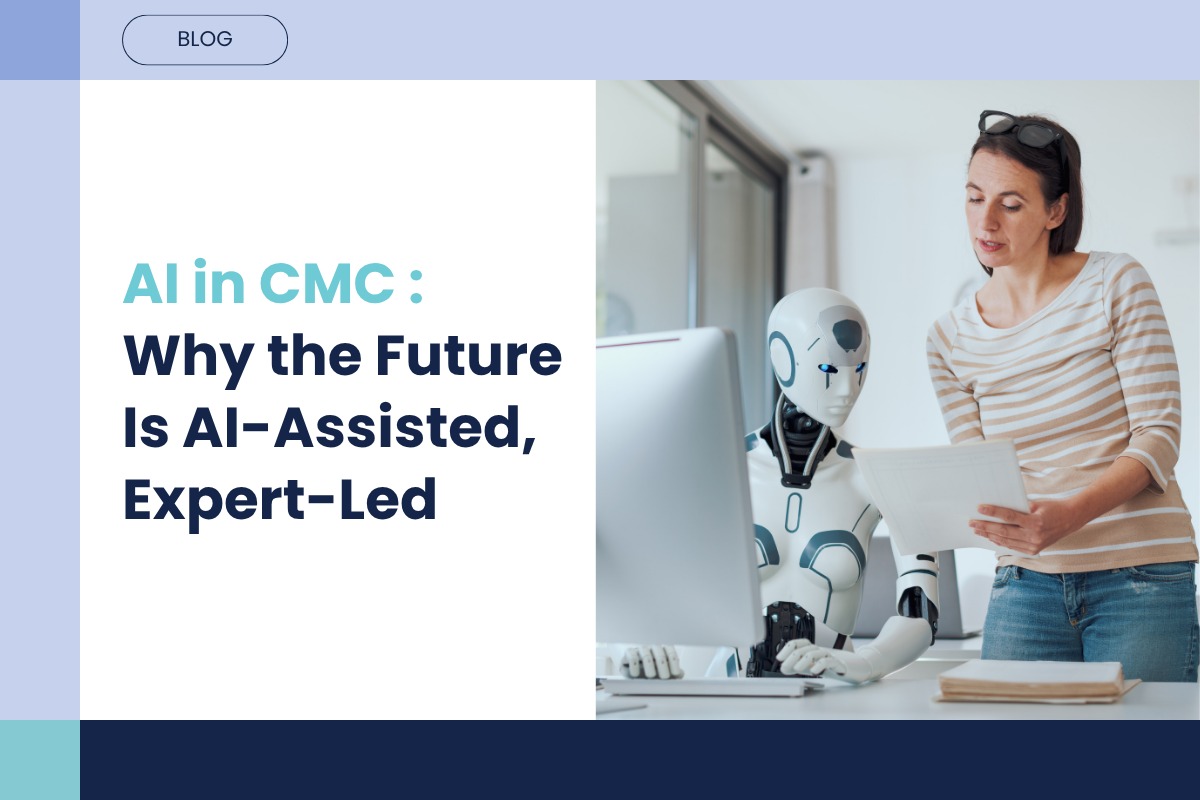
The most successful organizations recognize that AI and human expertise are complementary rather than competing forces.
Technology provides scalability.
Experts provide judgement.
Technology accelerates analysis.
Experts drive decisions.
Technology identifies possibilities.
Experts determine priorities.
The future belongs to organizations that effectively combine both.
The Emergence of the Human-AI Regulatory Organization
Leading life sciences companies are moving toward a new operating model built around Human-AI collaboration.
In this model, AI acts as an intelligent regulatory assistant that continuously supports experts throughout the product lifecycle.
AI enables:
- Intelligent information retrieval
- Automated content comparison
- Submission knowledge mining
- Regulatory change monitoring
- Cross-document consistency verification
- Impact assessment support
- Risk detection and trend analysis
Human experts enable:
- Strategic regulatory planning
- Scientific and technical assessment
- Benefit-risk evaluation
- Health authority engagement strategies
- Governance and compliance oversight
- Final decision making
The combination creates a regulatory function that is faster, smarter, and more resilient.
Rather than spending hours locating information, experts can focus on interpreting information.
Rather than managing routine administrative activities, they can drive strategic programs that influence product development, manufacturing, and market access outcomes.
This evolution elevates regulatory affairs from an operational necessity to a strategic business capability.
Regulatory Intelligence as a Competitive Advantage
As pharmaceutical organizations accelerate their digital transformation journeys, regulatory intelligence is emerging as a strategic capability that can drive measurable business value across the product lifecycle. The convergence of AI, advanced analytics, and regulatory expertise is enabling organizations to move beyond reactive compliance toward proactive, insight-driven decision-making.
Companies that successfully embed AI-powered regulatory intelligence into their operating models stand to gain significant advantages:
- Proactive Risk Management
Rather than identifying issues during regulatory review, organizations can leverage intelligent analytics to detect potential risks, gaps, and inconsistencies earlier in the development and submission process. This allows teams to mitigate challenges before they impact timelines, approvals, or compliance outcomes.
- Elevated Submission Excellence
AI-enabled content analysis, consistency validation, and knowledge reuse help strengthen the quality and reliability of regulatory submissions. By improving accuracy and alignment across documents, organizations can enhance submission readiness and reduce the likelihood of regulatory queries.
- Accelerated Strategic Decision-Making
While regulatory expectations continue to evolve, business timelines are becoming increasingly compressed. Access to timely, data-driven insights empowers regulatory leaders and cross-functional teams to make faster, more informed decisions with greater confidence.
- Optimized Lifecycle Management
Regulatory intelligence provides greater visibility into the implications of manufacturing changes, global market-specific requirements, and post-approval obligations. This enables a more coordinated and strategic approach to lifecycle management and change implementation.
- Increased Organizational Agility
In a rapidly changing global regulatory environment, organizations must be able to respond quickly without compromising compliance. Intelligence-driven regulatory functions are better equipped to adapt to evolving requirements, support business priorities, and maintain operational excellence.
Ultimately, as the pharmaceutical industry becomes increasingly data-centric, the ability to transform regulatory information into actionable intelligence will be a defining characteristic of high-performing organizations. In many respects, the organizations that lead tomorrow will not only be distinguished by scientific innovation, but also by how effectively they harness regulatory intelligence to drive faster, smarter, and more confident decisions.
Looking Ahead: The Future of CMC
The next decade will redefine how regulatory organizations create value.
Success will no longer be determined by the volume of documentation an organization can produce. It will be determined by how effectively it can transform information into insight, insight into strategy, and strategy into execution.
AI will play a critical role in this transformation, but technology alone will not deliver regulatory excellence.
The organizations that thrive will be those that combine advanced digital capabilities with deep scientific and regulatory expertise.
At Celegence, we believe the future of CMC lies at the intersection of intelligent technology and human ingenuity. Regulatory intelligence is not simply a technological advancement; it represents a fundamental evolution in how organizations manage complexity, mitigate risk, and accelerate innovation.
As the industry moves beyond regulatory writing toward regulatory intelligence, the question is no longer whether AI will transform CMC.
The question is how effectively organizations can harness AI and human expertise together to shape the future of regulatory excellence.
Move Beyond Regulatory Writing
As CMC regulatory requirements become more complex, pharmaceutical companies need more than efficient document creation. They need reliable regulatory knowledge, stronger submission readiness, and expert-led decisions supported by technology.
Celegence combines CMC regulatory expertise, technical authoring, and AI-assisted workflows to help pharmaceutical companies improve the way they manage regulatory information and prepare submissions.
AUTHORED BY

Team Lead - Regulatory Affairs
Gyanendra Singh

Other Related Articles

13 Oct, 2026
07 Oct, 2026

02 Oct, 2026

09 Sep, 2026