"*" indicates required fields
The Great Convergence — Why 2026 is the Year Regulatory “Records” Die
10 Mar, 2026
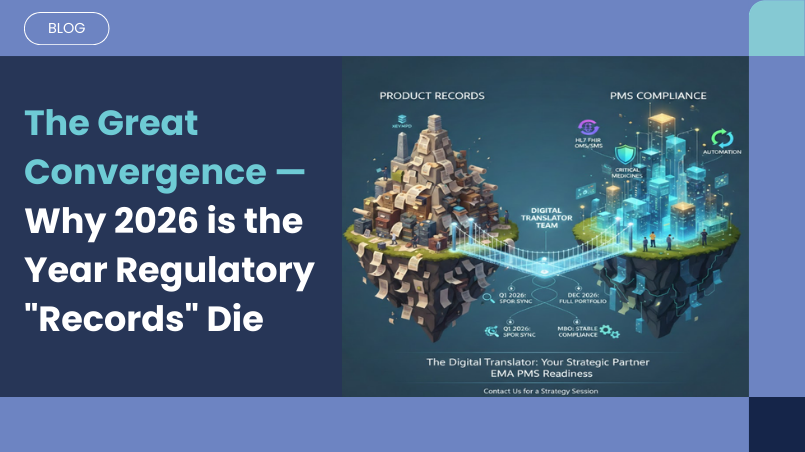
For decades, the Regulatory Affairs department has been a vault for Product Records. We’ve been librarians of PDFs, masters of the Word document, and archivists of scanned certificates. While these records contain the “truth,” it is a truth locked in silence. Machines cannot read a PDF to predict a drug shortage or cross-reference an excipient across a global portfolio in seconds.
As we move through 2026, the European Medicines Agency (EMA) is forcing a fundamental pivot. We are leaving the era of the Record and entering the era of Product Data.
The EMA Product Management Service (PMS) changes the game. It requires your regulatory truth to be broken down into structured data objects (HL7 FHIR).
The 2026 Compliance Destination: PMS
The Product Management Service (PMS) is not just another database; it is the “Digital Twin” of your entire portfolio. By the end of this year, every authorized medicine in the EU must transition from a static Article 57 (xEVMPD) entry into a high-fidelity, ISO IDMP-compliant data object.
The Milestone Map for 2026-27
To reach the destination of PMS compliance, Marketing Authorisation Holders (MAHs) must navigate three critical deadlines:
- June 2026 (The “Critical” Gateway) : Enrichment of structured manufacturer data and pack sizes for all products on the Union List of Critical Medicines. This is the EMA’s priority to ensure supply chain visibility.
- December 2026 (Full Supply Chain Transparency) : Mandatory submission of structured manufacturer data for the entire non-centrally authorized (non-CAP) portfolio.
- June 2027 (The Final Detail) : The deadline for enrichment of all remaining pack size details for non-CAPs.
Real-Time Examples: The Record vs. The Data
| Feature | The Old Way (Product Record) | The New Way (Product Data) |
| Strength | A string in a PDF: “10mg/ml” | Four discrete data fields: Numerator=10, Unit=mg, Denominator=1, Unit=ml. |
| Manufacturer | A name on a page: “Site X, Lyon” | A unique OMS Loc-ID linked to a global GPS-verified entry. |
| Pack Size | Mentioned in Section 6.5 of SmPC. | A structured PCID (Package ID) that feeds the Shortage Platform. |
Why 2026 is the “Point of No Return”
The EMA has set clear milestones that turn this theory into a legal mandate:
- June 2026: Deadline for enrichment of Critical Medicines (ULCM). Finalize SPOR synchronization. If your manufacturers aren’t in OMS, you can’t submit PMS data.
- December 2026: Deadline for structured Manufacturer Data for all other non-CAPs. Complete “Critical Medicines” enrichment. Use the PUI (Product User Interface) for bulk edits.
- Late 2026: Deployment of the PMS API FHIR R5 upgrade, which will be the standard for machine-to-machine communication. Finalize structured manufacturer data for the remaining portfolio.
The goal isn’t just to “pass” a deadline. Transitioning to product data enables:
- Automated eAFs: Pre-filling variation forms with zero manual entry.
- Shortage Prevention: Real-time visibility into your supply chain via the ESMP.
- Agile Compliance: Updating a single data field instead of re-submitting an entire dossier.
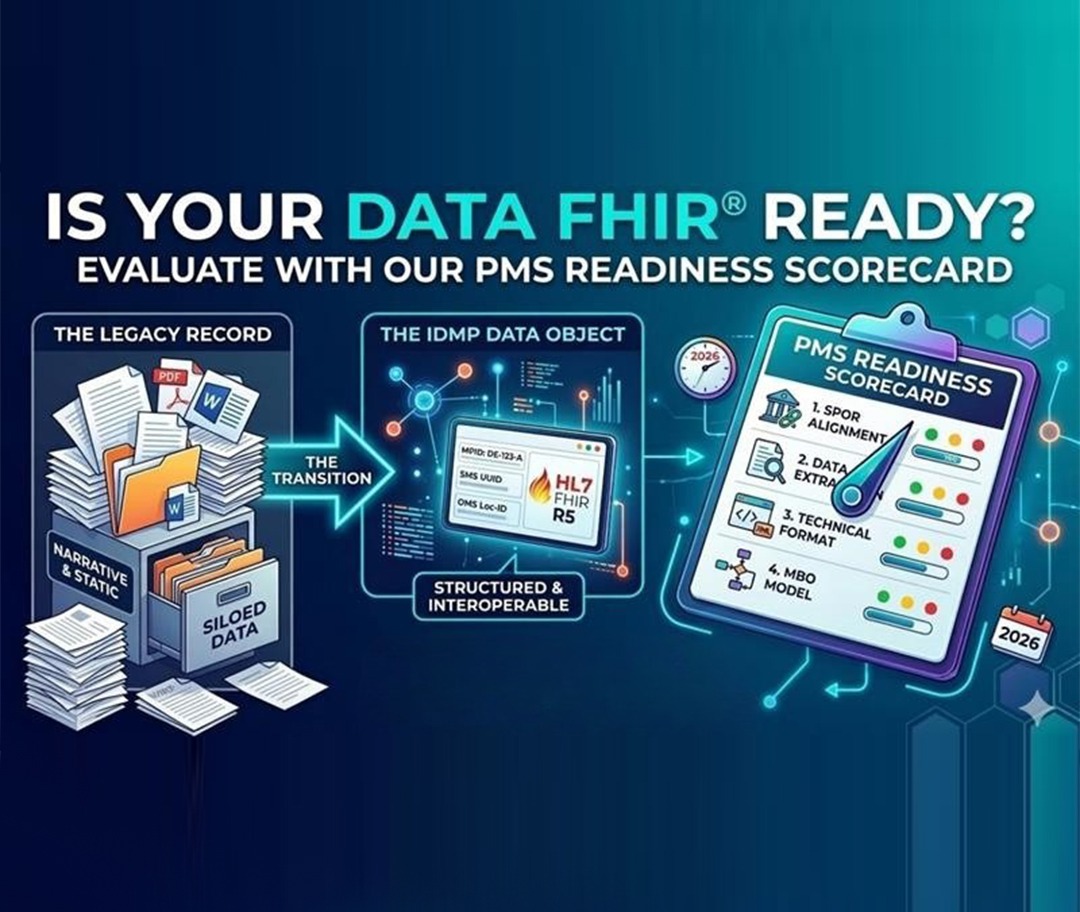
Your IDMP Readiness Scorecard – High-level assessment tool.
| Milestone | Readiness Metric | Target Date |
| SPOR Alignment | Are all manufacturers registered in OMS? | Q1 2026 |
| Data Extraction | Is the 213 IDMP-attribute set extracted from SmPC/M3, etc? | Q2 2026 |
| Technical Format | Can your system export HL7 FHIR R5? | Q3 2026 |
| MBO Model | Is there a defined process for data updates? | Dec 2026 |
Are You Still Filing Records, or Are You Managing Data?
To help you identify exactly where your team stands, Download your Free IDMP Readiness & PMS Compliance Checklist and use this tool to evaluate your current state.
Let’s Secure Your Destination
Are you looking for an extended team to ensure stable compliance and high-quality data migration?
If you are navigating the complexities of RIM implementation, IDMP readiness, PMS compliance, eAF transition filling, or searching for a reliable partner to augment your regulatory staff, we are here to support your journey.
Why Partner With Us?
- Reduced Compliance Risk : Avoid the “rejection loop” by getting the data structure right the first time.
- Cost Efficiency : Leverage an offshore/nearshore extended team model to manage high-volume data cleanup without bloating your internal headcount.
- Future-Proofing : We don’t just solve for 2026; we build the data architecture that supports future automation, AI, and eAF integration.
Contact Us / Book a Strategy Session
Let’s discuss how we can turn your regulatory records into a strategic data advantage.
AUTHORED BY

Senior SME, Regulatory Services
Sowmya Raju


Other Related Articles
05 Jun, 2026
07 May, 2026

10 Apr, 2026

26 Mar, 2026

24 Feb, 2026