

Received a Notified Body Deficiency Letter for Your CER? Here’s What to Do Next
Dental Medical Devices: Special Considerations for Clinical Evaluation Under EU MDR
22 Apr, 2026
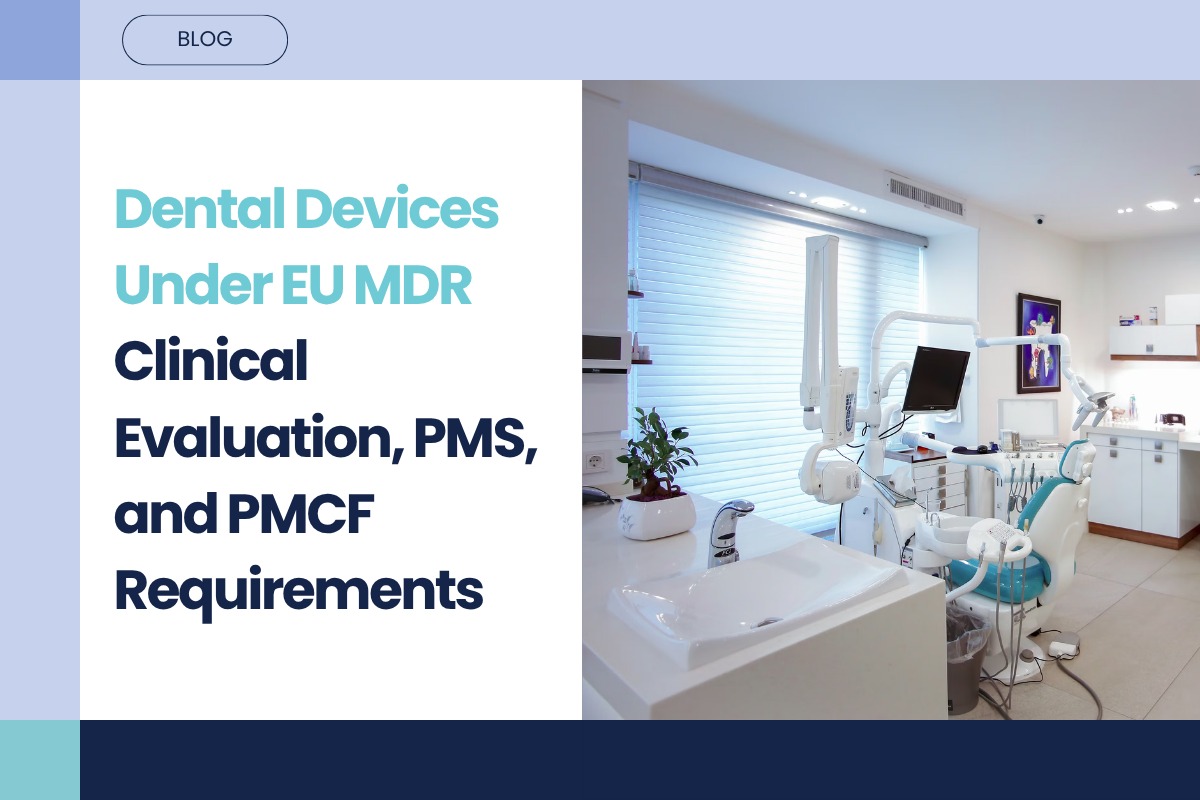
The European Union Medical Device Regulation (EU MDR 2017/745) has fundamentally changed how dental devices are regulated in Europe. While dentistry was already regulated under the former Medical Device Directive (MDD), the MDR introduces significantly higher scrutiny, particularly for implants, restorative materials, and custom‑made dental devices. For dental device manufacturers, distributors, and dental laboratories, understanding these special considerations is essential to maintain CE marking and uninterrupted market access.
The MDR is applicable for all medical devices including products used for cleaning, sterilization, or disinfection. This article is related to the MDR from the dental perspective and the requirements related to clinical data and post-market clinical follow-up (PMCF). Dental devices operate in a complex oral environment and increasingly use bioactive materials, nanoparticles, and fluoride-releasing components, raising additional safety and performance considerations. Dental devices span a wide risk range, from low‑risk hand instruments to high‑risk implantable products that permanently interact with bone and soft tissue. Under the EU MDR, regulators recognize that dental devices frequently involve long‑term or permanent implantation, tissue integration, and combined biological, chemical, and mechanical risks.
Consequently, dental implants, bone substitutes, and restorative materials are subject to heightened clinical evidence requirements and increased post‑market scrutiny compared with many other medical device categories.
Classification of Devices under EUMDR
One of the most significant changes under the MDR is device up‑classification. Many dental devices previously classified under lower risk categories in the MDD have moved to higher risk classes under MDR Annex VIII.
Typical examples include:
- Dental implants classified as Class IIb or Class III
- Bone grafts and resorbable materials classified as Class III when biologically active or absorbed
- Crowns and bridges classified as Class I or IIa, depending on invasiveness and duration of contact
This reclassification results in mandatory Notified Body involvement, more extensive clinical evaluation, and stricter post‑market clinical follow‑up (PMCF) requirements. As a result, incorrect classification has become a common cause of CE certification delays or rejections.
Clinical Evidence Expectations
Under the EU MDR (Regulation (EU) 2017/745), clinical evaluation is a continuous lifecycle requirement in accordance with Article 61 and Annex XIV, rather than a one‑time pre‑market activity. Dental devices are subject to increased scrutiny due to their use in high‑load oral environments and the potential for serious, irreversible clinical consequences in the event of failure.
To demonstrate conformity with the General Safety and Performance Requirements (Annex I), manufacturers must establish a Clinical Evaluation Plan (CEP) and maintain a robust Clinical Evaluation Report (CER) as specified in Annex XIV, Part A. A documented State of the Art (SOTA) review is required to contextualize safety and performance against current clinical practice.
For most Class IIb dental devices and all Class III devices, Post‑Market Clinical Follow‑Up (PMCF) is generally expected in line with Article 61(11) and Annex XIV, Part B. While legacy dental devices often rely on systematic literature appraisal, equivalence claims are significantly restricted under Article 61(4)–(6), frequently necessitating additional clinical or PMCF‑derived evidence.
Special Considerations :
Dental devices are subject to specific MDR requirements that go beyond traditional compliance expectations, particularly for implantable products, custom‑made devices, and material safety. Dental implants are significantly impacted by enhanced transparency obligations, including Implant Cards (Article 18) to support patient traceability and Summaries of Safety and Clinical Performance (SSCPs) for public access via EUDAMED, requiring manufacturers to communicate risks and benefits in a clear, patient‑friendly manner rather than purely technical terms.
In parallel, custom‑made dental devices (CMDs) – such as patient‑specific crowns, bridges, custom abutments, and prescribed orthodontic appliances – are not exempt from MDR oversight; while CE marking is not required, manufacturers must comply with the General Safety and Performance Requirements (Annex I), maintain technical documentation, issue a Manufacturer’s Statement (Annex XIII), and implement robust risk management and post‑market surveillance systems. Notably, MDCG guidance clarifies that mass‑produced CAD/CAM devices merely adapted to individual patients are not automatically considered custom‑made, a common compliance pitfall for dental laboratories.
Additionally, dental materials face heightened scrutiny due to continuous saliva exposure, thermal cycling, and long‑term contact with mucosal tissue or bone, requiring manufacturers under Annex I to demonstrate ISO 10993‑based biocompatibility, justify chemical composition (e.g., alloys, polymers, ceramics), and assess long‑term degradation, wear, sensitization, and toxicity risks.
Importance of PMS and Post-Market Clinical Follow-Up (PMCF)
Under the EU MDR, dental implants and bioactive dental materials are subject to stringent post‑market evidence generation requirements to confirm long‑term safety and performance under real‑world conditions. In accordance with Articles 83–86 and Annex III, manufacturers must implement proactive Post‑Market Surveillance (PMS) systems, including trend reporting under Article 88, to systematically collect and analyze post‑market data beyond adverse event detection.
For Class IIb and Class III implantable dental devices, Periodic Safety Update Reports (PSURs) are mandatory under Article 86, requiring a critical reassessment of benefit–risk, clinical performance, and safety based on accumulated PMS data. In parallel, Post‑Market Clinical Follow‑Up (PMCF) activities are generally expected for dental implants and bioactive materials in line with Article 61(11) and Annex XIV, Part B, to confirm clinical claims, identify emerging risks such as peri‑implant complications or material degradation, and support the ongoing conclusions of the Clinical Evaluation Report (CER).
Notified Bodies increasingly expect PMS and PMCF outputs to actively substantiate clinical performance and benefit claims, rather than serving solely as reactive vigilance tools.
Practical Strategies for Dental Device Manufacturers
Meeting MDR clinical evidence expectations can be challenging, particularly for small and medium-sized manufacturers in the dental sector. However, several practical strategies can help streamline compliance.
- Manufacturers should develop a clinical strategy early in the product development process. Aligning regulatory, clinical, and R&D teams helps ensure that necessary data will be available at the time of regulatory submission.
- Generating robust preclinical data, including mechanical testing, biocompatibility studies, and chemical characterization—can reduce uncertainty and support clinical evaluation.
- PMCF planning should begin during device development, allowing manufacturers to collect valuable post-market evidence efficiently.
- Manufacturers should pay particular attention to emerging materials such as nanoparticles or bioactive compounds, which may require additional toxicological or clinical assessments.
- Ongoing literature surveillance is essential to maintain an up-to-date clinical evaluation throughout the device lifecycle.
Conclusion
EU MDR does not merely add documentation – it demands regulatory maturity. Dental device manufacturers must adopt:
- Early and defensible classification strategies
- Proportionate but robust clinical evidence planning
- Lifecycle‑based PMS and PMCF
- Clear differentiation between standard, patient‑matched, and custom‑made devices
Although these requirements may increase regulatory complexity, they ultimately support improved patient safety, better clinical outcomes, and greater confidence in dental technologies within the European market.
For manufacturers who proactively integrate clinical strategy, risk management, and post-market evidence generation, MDR compliance can also become a valuable opportunity to demonstrate the quality and reliability of their products.
Reach out to info@celegence.com to learn more.
AUTHORED BY

SENIOR SME, MEDICAL DEVICE SERVICES
Alpa Ben

Other Related Articles

13 Aug, 2026
06 Aug, 2026

04 Aug, 2026

29 Jul, 2026

29 Jul, 2026

22 Jul, 2026