
Technology Transfer in Pharma: Best Practices for Successful CMC and Regulatory Compliance
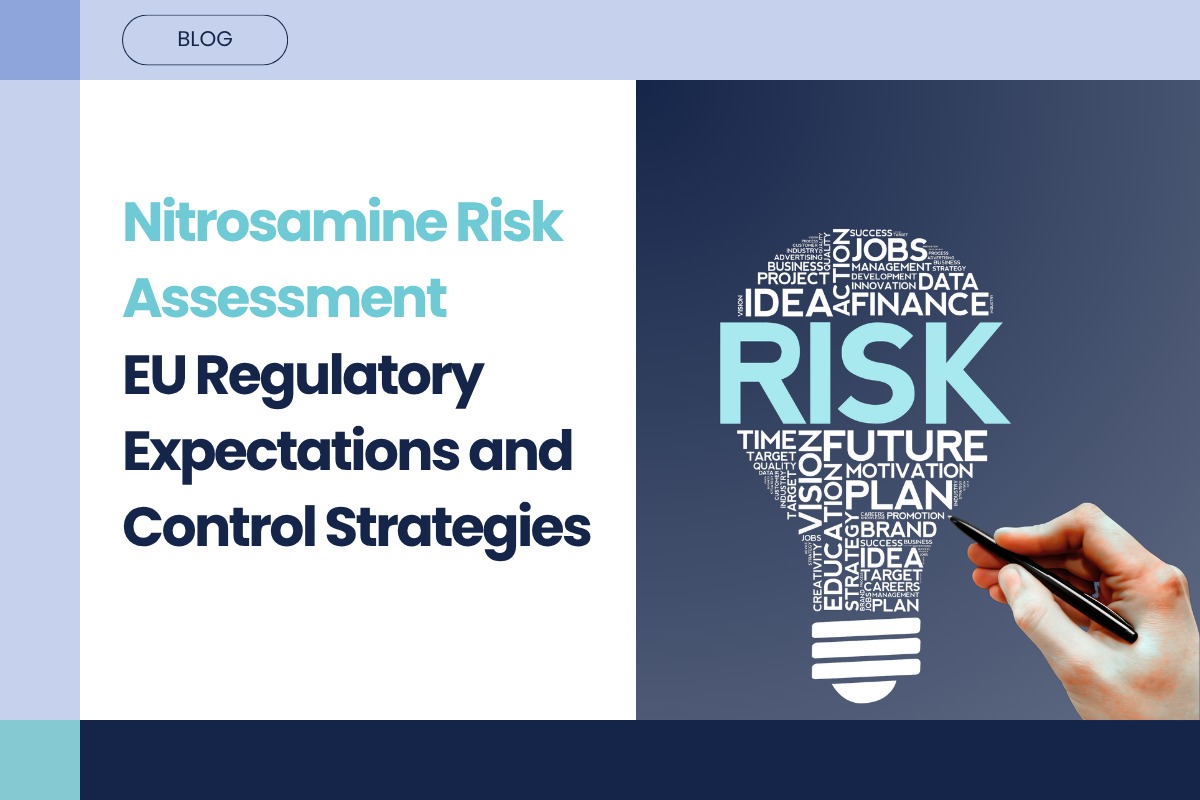
Nitrosamine Control Insights: Clarity and Control in EU Risk Assessment
07 May, 2026
Introduction
Since 2018, nitrosamine impurities have become a major regulatory focus after unexpected levels were detected in certain sartan medicines, triggering recalls and global investigations. Nitrosamines are classified as probable human carcinogens, and even trace quantities can present long-term safety concerns.
In the EU, the European Medicines Agency (EMA) and the Heads of Medicines Agencies (HMA) introduced a structured framework requiring all marketing authorisation holders and applicants to assess and control nitrosamine risk. Today, nitrosamine risk assessment is a mandatory regulatory requirement and a core public health priority.
This article outlines the EU framework, the EMA’s three-step approach, and practical strategies to manage nitrosamine risks across the product lifecycle.
What Are Nitrosamines and Why Do They Matter?
Nitrosamines are chemical compounds that can form unintentionally when nitrosatable amines react with nitrosating agents (commonly nitrites) under conducive conditions such as acidic pH, elevated temperature, or moisture.
They may arise during:
- API synthesis
- Drug product manufacturing
- Storage and degradation
- Packaging interactions
- Cross-contamination in shared facilities
Formation typically requires three elements:
- A secondary or tertiary amine
- A nitrosating agent (e.g., nitrite)
- Suitable reaction conditions (pH, heat, moisture)
Because nitrosamines are associated with a potential lifetime cancer risk, their presence above acceptable intake (AI) limits can lead to recalls, supply disruptions, and regulatory enforcement actions.
EMA’s Three-Step Risk Assessment Framework
The European Medicines Agency has established a mandatory three-step process for all human medicinal products.
Step 1: Risk Evaluation
A comprehensive assessment must cover both the active substance and the finished product.
API Manufacturing Review
- Evaluate synthetic routes, reagents, solvents, and intermediates
- Identify use of amine-containing solvents (e.g., DMF, DMAc, NMP)
- Assess potential contamination from raw materials or shared equipment
- Obtain supplier and CMO risk assessments
Drug Product Review
- Evaluate excipients, solvents, and packaging materials
- Collect nitrosamine-related declarations from suppliers
- Assess risks from wet granulation, hygroscopic formulations, or humid storage
Degradation Pathways
- Review stability data and stress studies
- Identify nitrogen-containing functional groups
- Evaluate potential in situ formation over shelf life
This stage must scientifically justify whether a risk exists or can be excluded.
Step 2: Confirmatory Testing
If risk cannot be ruled out, confirmatory testing is required using sensitive, validated methods such as LC-MS or GC-MS capable of detecting trace levels.
Key principles include:
- Testing is required unless robust scientific justification excludes risk
- Results below 10% of the AI may be considered negligible but must be documented
- Results at or above AI must be reported immediately to authorities
- Corrective and preventive actions (CAPAs) must be implemented when needed
Analytical methods must demonstrate sufficient sensitivity, specificity, and robustness to meet EU expectations.
Step 3: Risk Mitigation
Where risk is confirmed or remains possible, mitigation strategies must address the root cause.
API-Level Mitigation
- Replace high-risk solvents (e.g., DMF, DMAc, NMP)
- Avoid nitrosating agents and amine bases
- Optimise pH, quenching, and drying steps
- Introduce purification or route redesign to purge impurities
- Adjust salt forms or polymorphism where relevant
Drug Product-Level Mitigation
- Select excipients with low nitrite content
- Evaluate supplier variability (nitrite levels often ~1–2 ppm or lower, with exceptions such as crospovidone and magnesium stearate)
- Control moisture, pH, and drying parameters
- Avoid high-risk packaging (e.g., nitrocellulose-based materials if contributory)
- Consider nitrite scavengers or approved pH modifiers where justified
No universal regulatory nitrite limits exist for excipients; manufacturers must define controls based on product-specific risk assessment.
Structured Nitrosamine Risk Assessment
An effective control strategy includes:
- Product prioritisation based on molecular risk
- Quality risk management aligned with ICH Q9
- Toxicological assessment of identified nitrosamines
- Calculation of acceptable intake limits
- Ongoing testing and refinement
This process must be documented and maintained throughout the lifecycle.
Acceptable Intake Limits and Combined Risk
The EMA has established substance-specific AIs for certain nitrosamines, including:
- NDMA: 96 ng/day
- NDEA: 26.5 ng/day
These limits correspond to a theoretical lifetime cancer risk below 1 in 100,000.
If multiple nitrosamines are present, companies must either:
- Ensure total intake does not exceed the AI of the most potent compound, or
- Apply a combined risk calculation approach
For nitrosamines lacking compound-specific data, a class-based Threshold of Toxicological Concern (TTC) of 18 ng/day may apply, provided justification is consistent with ICH M7 (R1). Structure–activity relationship (SAR) and read-across approaches may refine acceptable limits when appropriate.
Expectations for Generic Applications
For generics and all marketing authorisation applications, nitrosamine control is mandatory.
Authorities expect applicants to:
- Demonstrate robust process understanding, not just “not detected” results
- Perform confirmatory testing where risk cannot be excluded
- Update CTD Modules 3.2.S and 3.2.P when mitigation changes occur
- Submit appropriate EU variations when manufacturing or packaging changes are introduced
- Continuously update risk assessments in line with evolving EMA guidance and European Pharmacopoeia requirements
Superficial or template-based assessments are increasingly challenged.
Advanced and Special Situations
Oncology Products
For advanced cancer therapies within the scope of ICH S9, higher impurity limits may be acceptable due to limited life expectancy and urgent clinical need. Nitrosamines may be assessed under general impurity frameworks such as ICH Q3A (R2) and ICH Q3B (R2) rather than strict chronic-use AI limits.
Mutagenic APIs
If the API itself is mutagenic, nitrosamine control falls within the broader framework of ICH M7 (R1). The total mutagenic burden and benefit–risk balance guide acceptable control levels.
Less-Than-Lifetime (LTL) Approaches
In exceptional cases where immediate compliance is technically infeasible, temporary higher limits may be accepted using LTL calculations under ICH M7 principles. These are case-specific and require a clear reduction plan.
Key Challenges
Nitrosamine risk management is complex due to:
- Excipient and supplier variability
- Analytical sensitivity requirements
- Stability and degradation dynamics
- Cost and process redesign implications
- Post-approval regulatory impact
Changes introduced for mitigation often require variations and supporting data, potentially affecting timelines and supply continuity.
Key Takeaways
- Nitrosamine formation requires an amine, a nitrosating agent, and conducive conditions—removing any one element reduces risk.
- Mitigation must be root-cause based and scientifically justified.
- Water activity, pH, excipient nitrite content, and packaging interactions significantly influence formation potential.
- Risk assessment is a continuous lifecycle obligation, not a one-time exercise.
Conclusion
Nitrosamine control is no longer reactive compliance—it is an embedded regulatory expectation across the EU. The European Medicines Agency requires a proactive, science-driven, lifecycle-based strategy integrating risk evaluation, confirmatory testing, and robust mitigation.
Early integration during development reduces the risk of recalls, supply disruptions, and regulatory findings. A structured, well-documented approach ensures compliance while safeguarding patient safety and maintaining market continuity.
Effective nitrosamine control ultimately reflects a company’s commitment to quality, regulatory excellence, and long-term patient protection.
How Celegence Can Support
Celegence supports pharmaceutical companies in developing structured, science-driven nitrosamine risk management strategies aligned with evolving EMA and global regulatory expectations. Our teams help organizations assess, document, and mitigate nitrosamine risks across APIs, drug products, manufacturing processes, and packaging systems.
Our support includes:
- Nitrosamine risk assessments aligned with EMA guidance and ICH Q9 principles
- Gap analysis and mitigation strategy development
- CTD Module 3 documentation support for regulatory submissions and variations
- Evaluation of excipient, supplier, and packaging-related nitrosamine risks
- Lifecycle management support for post-approval changes and ongoing monitoring
- Regulatory strategy support for confirmatory testing and CAPA implementation
By combining regulatory expertise with structured quality and compliance approaches, Celegence helps manufacturers strengthen impurity control strategies while supporting patient safety and supply continuity.
To learn more, contact us at info@celegence.com
AUTHORED BY

Associate II, Technical Writing
Yeragonda Chandrakala

Other Related Articles
04 Aug, 2026
15 Jul, 2026
02 Jul, 2026

26 Jun, 2026

05 Jun, 2026