Why Regulatory Strategy Is a Capital Allocation Decision
Ethylene Oxide in Pharmaceuticals and Consumer products – Essential Intermediate, High-Risk Exposure – A Regulatory Deep Dive
26 Jun, 2026
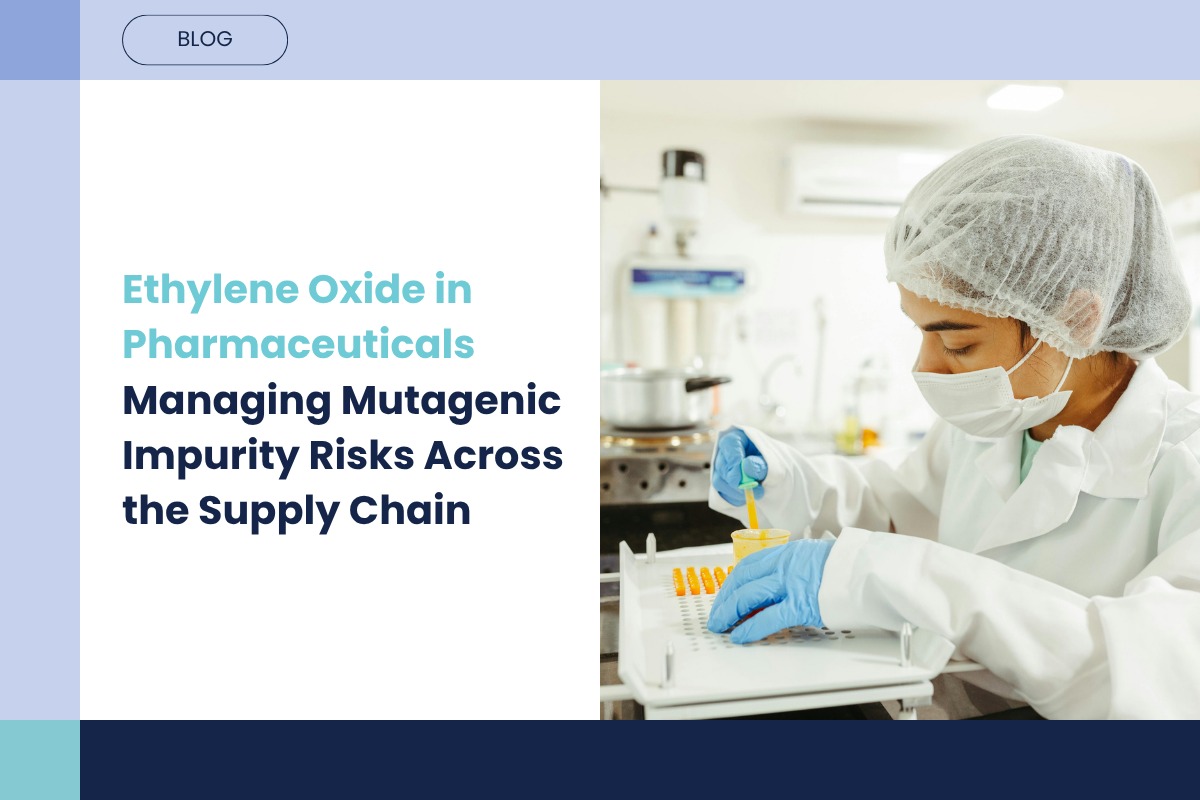
Ethylene oxide (EO) is one of the most widely produced industrial chemicals in the world. This small, highly reactive epoxide sits at the heart of countless value chains, from antifreeze and detergents to pharmaceuticals and medical devices. Yet behind its versatility lies a critical regulatory reality: EO is a mutagenic carcinogen that demands rigorous control across the pharmaceutical and consumer product lifecycle.
For Regulatory Affairs, Quality, and CMC professionals, EO is not just a chemistry topic—it is a strategic compliance priority.
From EO to PEG and PEO: The Hidden Upstream Link
EO rarely appears on a pharmaceutical certificate of analysis. Instead, its importance lies upstream.
When EO reacts with water, glycols, or alcohols, it forms polyethylene glycols (PEGs), polyethylene oxides (PEOs), and other ethoxylated derivatives across a spectrum of molecular weights. These materials are foundational pharmaceutical excipients used as:
- Solvents and co-solvents
- Tablet binders and lubricants
- Ointment and suppository bases
- Surfactants (e.g., polysorbates)
- PEGylation reagents for biologics
- Components in advanced drug delivery systems
Although EO itself is consumed during polymerisation, reaction conditions, purification steps, and stripping efficiency determine the impurity profile of the final excipient. In other words, EO may be invisible on the label—but it shapes the risk profile of the material.
Residual EO and Co-Impurities: What Must Be Controlled?
If synthesis and purification are not optimised, PEG-type excipients can retain trace levels of:
- Residual ethylene oxide
- Ethylene glycol (EG)
- Diethylene glycol (DEG)
- 1,4-Dioxane
- Formaldehyde
1,4-Dioxane is particularly concerning as it can form through dehydration pathways involving ethoxylated intermediates and is also classified as a potential carcinogen.
Modern pharmacopeial and supplier specifications often include limits such as:
- ≤ 1 ppm EO
- ≤ 10 ppm 1,4-dioxane
- Controlled levels of EG, DEG, and aldehydes
These limits are especially critical for parenteral and other high-risk dosage forms, where patient exposure must remain tightly controlled.
EO Under ICH M7 (R1): A Class 1 Mutagen
EO is a known mutagenic carcinogen and falls squarely within the scope of ICH M7 (R1).
Under ICH M7, Class 1 mutagenic impurities must be controlled to acceptable intake (AI) limits derived from lifetime cancer risk principles (typically 1 in 100,000). This means:
- EO cannot simply be “low”—it must be justified toxicologically.
- Acceptable limits must align with dosage, route of administration, and duration of therapy.
- Control must be risk-based, science-driven, and documented.
Manufacturers may apply ICH M7 control options such as:
- Fate and purge arguments demonstrating removal during processing
- Process understanding showing destruction or stripping efficiency
- Specific analytical control at excipient or drug product level
The same framework may apply to other EO-related mutagenic impurities such as 1,4-dioxane where relevant.
Analytical Methods and QC Strategy
Robust analytical capability is essential for EO risk management.
Common tools include:
- Headspace GC for volatile EO
- GC-MS for EO and 1,4-dioxane
- Rapid quantitation methods tailored to polymeric matrices
Key quality control considerations:
- Defined LOQs aligned with ICH M7 limits
- Routine testing or justified skip-testing strategies
- Periodic confirmatory testing within the pharmaceutical site
- Trending of impurity levels over time
EO impurity testing should be embedded into raw material control strategies, not treated as an exceptional investigation tool.
Supplier Qualification and Lifecycle Management
EO-derived excipients (PEGs, polysorbates, alcohol ethoxylates, castor oil ethoxylates) must be treated as higher-risk raw materials due to mutagenicity and secondary carcinogen potential.
Technical and quality agreements should address:
- EO source and handling practices
- Reactor design and ethoxylation conditions
- Stripping and purification steps
- Control of 1,4-dioxane formation
- Batch testing frequency and CoA content
- Change notification timelines
Any changes to:
- EO source
- Polymerisation catalysts
- Purification conditions
- Reactor configuration
should trigger formal change control aligned with ICH Q7 and ICH Q9, including reassessment under ICH M7 where impurity profiles could shift.
Lifecycle governance is critical. EO control is not static—it must evolve with process, supplier, and regulatory changes.
Qualification Checklist for EO-Derived Raw Materials
A robust qualification framework should combine chemistry insight, toxicology, and supplier governance.
1. Material & Process Understanding
- Confirm EO derivation (PEG/PEO, polysorbates, alcohol ethoxylates).
- Request high-level process descriptions (EO source, reaction conditions, purification, downstream modification).
2. Specifications & Impurity Limits
- Ensure limits for EO, 1,4-dioxane, EG/DEG, aldehydes.
- Confirm compatibility with product-specific ICH M7 AI calculations.
- Pay particular attention to parenteral applications.
3. Analytical Methods
- Obtain validation summaries (specificity, sensitivity, robustness).
- Clarify batch testing vs skip testing approach.
- Understand deviation and out-of-trend handling.
4. Supplier Quality Systems
- Evaluate GMP certification and data integrity practices.
- Implement formal technical agreements.
- Secure audit rights and change notification commitments.
5. Risk Assessment
- Perform formal ICH Q9-based classification.
- Define internal impurity targets linked to product-level M7 assessments.
6. Incoming Testing & Monitoring
- Establish risk-based QC plans.
- Trend impurity data.
- Adjust testing frequency based on performance history.
Common Contamination Pathways
EO contamination is not limited to excipient synthesis. Key risk routes include:
- Residual sterilisation EO: When used intentionally as a sterilant, insufficient aeration may leave residues.
- Process residues in ethoxylates: Incomplete stripping can leave EO and 1,4-dioxane.
- Cross-contamination: Shared reactors or transfer lines without robust cleaning.
- Environmental migration: EO use in sterilisation rooms migrating via air systems.
- Weak supplier controls: Contaminated intermediates entering the supply chain.
Each pathway requires targeted risk assessment and preventive controls.
Sustainability and “Green EO”: Opportunity with Responsibility
Bio-circular or renewable EO routes are emerging as part of decarbonisation strategies. These can reduce product carbon footprint while delivering chemically equivalent PEGs.
However, “green” does not mean “low risk.”
Any new EO route must be:
- Fully qualified from a pharmacopeial standpoint
- Reassessed under ICH M7
- Evaluated for impurity profile shifts
- Controlled through formal change management
Sustainability initiatives must be aligned with impurity control rigor.
Why This Matters Now
EO-derived excipients are indispensable—but they carry disproportionate toxicological responsibility.
Regulatory and quality teams must act as integrators, linking:
- Chemistry understanding
- Toxicology and ICH M7 limits
- Analytical capability
- Supplier governance
- Lifecycle change control
Failure to manage EO-related impurities can result in regulatory findings, supply disruptions, recalls, and reputational damage.
Conclusion: Indispensable Yet High-Responsibility Materials
EO-based excipients underpin modern pharmaceutical formulation and drug delivery. Yet their upstream chemistry introduces mutagenic and carcinogenic impurity risks that demand explicit, science-driven control.
A coherent EO strategy requires:
- Product-level ICH M7 assessment
- Excipient-level impurity specifications
- Validated analytical methods
- Strong supplier qualification
- Continuous lifecycle monitoring
When managed proactively, EO-derived materials remain safe, compliant, and reliable building blocks of innovation. When overlooked, they become silent risk multipliers.
In today’s regulatory landscape, EO control is not optional—it is a defining test of mature pharmaceutical quality systems.
How Celegence Can Support
Celegence supports pharmaceutical manufacturers in developing robust impurity control strategies aligned with ICH M7, ICH Q9, and global regulatory expectations. Our teams help organizations assess, document, and manage risks associated with ethylene oxide-derived excipients, mutagenic impurities, and lifecycle compliance requirements.
By combining regulatory expertise with science-based risk management approaches, Celegence helps manufacturers strengthen compliance, maintain supply continuity, and support patient safety throughout the product lifecycle.
To learn more, contact us at info@celegence.com.
AUTHORED BY

SENIOR TECHNICAL WRITER - PHARMA REGULATORY SERVICES
Ganapathy IB

Other Related Articles

26 Aug, 2026

25 Aug, 2026

20 Aug, 2026
19 Aug, 2026

06 Aug, 2026
04 Aug, 2026