

Why Regulatory Strategy Is a Capital Allocation Decision
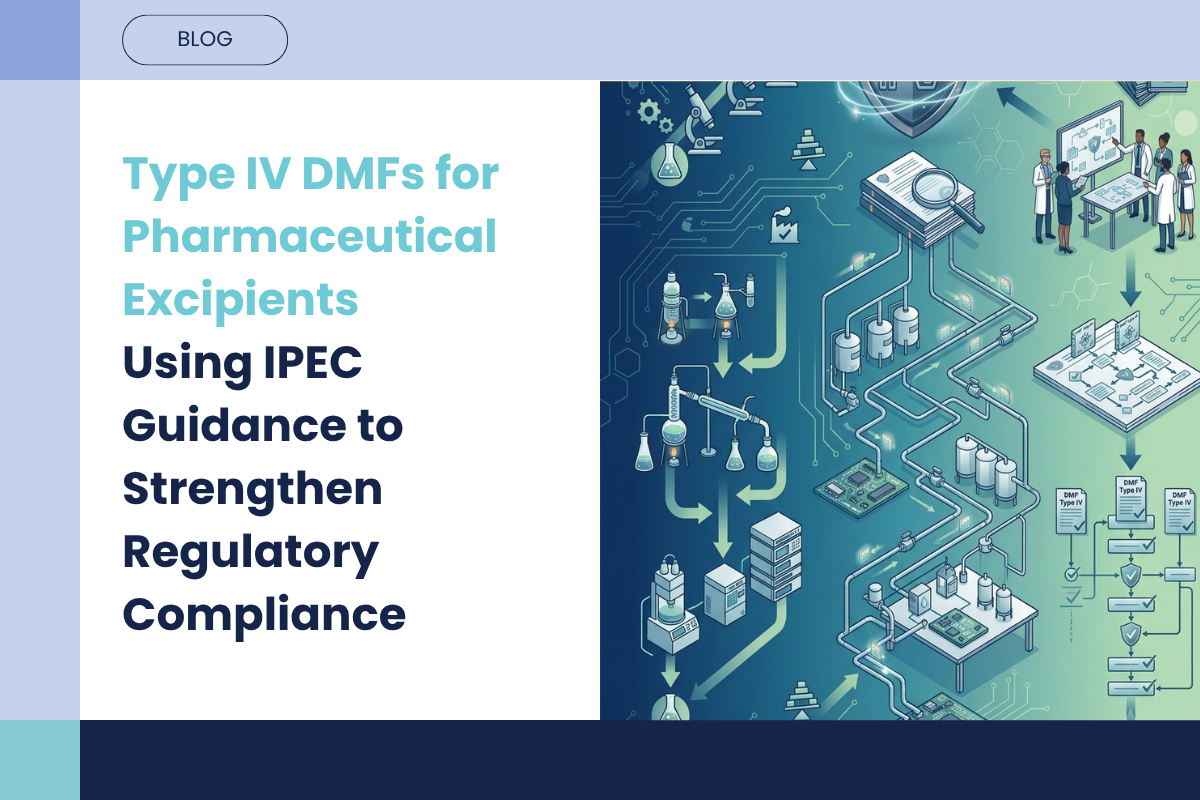
Beyond “Inactive”: Mastering Type IV DMFs for Excipients Using IPEC Guidance
02 Jul, 2026
Why excipient DMFs are no longer optional and how IPEC turns complexity into clarity
Introduction: When “Inactive” Ingredients Become Regulatory Game‑Changers
Excipients are often described as inactive ingredients, yet regulatory experience tells a very different story. A formulation delay, an unexpected FDA query, or a confidentiality concern can suddenly make an excipient the most critical component of a drug application.
This is where a Type IV Drug Master File (DMF) guided by IPEC (International Pharmaceutical Excipients Council) best practices becomes a strategic regulatory tool rather than a compliance burden.
According to the FDA, a Type IV DMF is intended for excipients, colorants, flavors, essences, or materials used in their preparation, and its submission is voluntary but strategic.
What Is a Type IV DMF And Why Does It Matter?
A Drug Master File (DMF) is a confidential submission to the US FDA that allows excipients, colorants, flavours and essences manufacturers to protect proprietary information while supporting multiple drug applications through a Letter of Authorization (LOA).
A Type IV DMF specifically covers excipients and enables:
- Protection of confidential manufacturing processes
- Regulatory support for multiple NDA/ANDA/IND submissions
- Consistent FDA review of excipient quality and safety
Importantly, DMFs are not approved or disapproved independently; they are reviewed only when referenced by a drug application.
The Role of IPEC: Bringing Structure to Type IV DMFs
Recognizing the lack of harmonized expectations for excipient submissions, IPEC‑Americas published the “Excipient Master File Guide”, which provides voluntary, best‑practice recommendations for Type IV DMFs.
What Makes the IPEC DMF Guide Essential?
The IPEC guide:
- Aligns Type IV DMFs with the ICH Common Technical Document (CTD) format
- Clarifies what excipient information is scientifically and regulatorily relevant
- Helps harmonize submissions across suppliers and regulators
- Emphasizes lifecycle management and change control
The guide’s primary focus is explicitly on U.S. Type IV excipient DMFs.
What Does IPEC Recommend for Type IV DMF Content?
Based on IPEC DMF-related guidance and CTD alignment:
IPEC‑Recommended CTD Structure
- Module 1: Administrative Information
U.S.‑specific regulatory and administrative content, including DMF cover letter, holder details, Letters of Authorization (LoAs), and lifecycle commitments. - Module 2: Quality Summary
A concise Quality Overall Summary outlining the excipient, manufacturing controls, key specifications, and stability conclusions. - Module 3: Detailed Quality Data
The core of the Type IV DMF, providing comprehensive information on raw materials, manufacturing process, in‑process controls, specifications, analytical methods, stability data, and packaging. - Module 4 (Optional): Toxicology Reports
Generally not required for well‑established excipients with a history of safe use.
Recommended for novel excipients, new routes of administration, or increased exposure levels, where nonclinical safety support is necessary.
IPEC notes that toxicology sections are often omitted for well-established excipients, but should be included for novel ones.
GMP Expectations: The Backbone of DMF
IPEC–PQG GMP guidelines emphasize:
- Excipients must be manufactured under appropriate GMP systems
- GMP ensures:
- Batch consistency
- Risk control
- Patient safety
Unlike APIs, excipients don’t have strict GMP regulations, but industry-accepted IPEC GMP standards are expected globally.
Real-World Scenario: How a Type IV DMF Saves the Day
Imagine a mid-sized excipient manufacturer developing a novel co-processed excipient (e.g., a lactose-microcrystalline cellulose blend with enhanced flow properties) for oral solid dosages. Without a DMF:
- Every drug sponsor using it would demand full proprietary manufacturing details under confidentiality agreements.
- Regulatory reviews would slow down, delaying filings.
- The manufacturer risks exposing trade secrets.
With a Type IV DMF (following IPEC guidance):
- The manufacturer submits once to the FDA (CTD-structured: detailed process, specs, stability, and safety data justifying use up to X mg/day).
- Sponsors simply include the DMF number and LOA in their NDA/ANDA.
- FDA reviewers access confidential info seamlessly during drug application review.
- Result: Faster market access for multiple clients, protected IP, and demonstrated GMP alignment. Annual updates or significant change notifications keep it current.
Another scenario: A global supplier of a compendial excipient with a modified manufacturing site. IPEC’s change management framework helps classify the change (significant or not), triggering timely FDA notification if needed—avoiding compliance pitfalls
Common Misconception: “USP Compliance Is Enough”
While USP–NF monographs establish public quality standards, they do not replace a DMF when proprietary manufacturing information or novel processing is involved.
IPEC clearly states that a Type IV DMF supplements compendial compliance it does not replace it.
Regulatory Expectations: Voluntary but Strategic
The FDA explicitly states that submission of a DMF is not legally required; however, it is often the most efficient regulatory pathway, especially for:
- Novel excipients
- Proprietary manufacturing processes
- Multi‑customer excipient supply chains
Conclusion: Turning Guidance into Regulatory Advantage
A Type IV DMF developed using IPEC guidance transforms excipient documentation from a defensive compliance exercise into a proactive regulatory asset.
For regulatory professionals, understanding and applying IPEC recommendations means:
- Fewer FDA questions
- Better client confidence
- Stronger lifecycle control
- Protection of confidential know‑how
In today’s complex regulatory environment, excipients no longer sit quietly in the background—and neither should their DMFs.
How Celegence Can Support
Celegence supports excipient manufacturers, pharmaceutical companies, and regulatory teams in developing high-quality regulatory documentation that aligns with FDA expectations and industry best practices. Our experts help organizations build structured, compliant, and lifecycle-ready Type IV DMFs while protecting proprietary manufacturing information.
Our support includes:
- Type IV DMF preparation and gap assessments
- CTD Module 2 and Module 3 authoring and quality review
- Excipient regulatory strategy and documentation support
- Change control and lifecycle management for DMFs
- Technical documentation aligned with IPEC guidance and FDA expectations
- Regulatory support for novel excipients and proprietary manufacturing processes
- CMC and quality documentation for global regulatory submissions
By combining regulatory expertise with structured documentation processes, Celegence helps organizations strengthen compliance, protect confidential know-how, and support efficient FDA reviews across multiple drug applications. To learn more, contact us at info@celegence.com
References
- FDA – Guideline for Drug Master Files (DMF)
https://www.fda.gov/drugs/drug-master-files-dmfs/guideline-drug-master-files-dmf - IPEC‑Americas – Excipient Master File Guide
https://www.jpec.gr.jp/document/ExcipientMasterfileGuide.pdf - IPEC‑Americas – U.S. DMF Guide Publication
https://www.multibriefs.com/briefs/ipec/DMF_Guide_Published.pdf - IPEC‑Americas – FAQs on Type IV DMFs
https://ipecamericas.org/what-ipec-americas/excipient-faqs
AUTHORED BY

Senior Technical Writer - Regulatory Services (Pharma)
Priya Bolia

Other Related Articles

26 Aug, 2026

25 Aug, 2026

20 Aug, 2026
19 Aug, 2026

06 Aug, 2026
04 Aug, 2026