Beyond “Inactive”: Mastering Type IV DMFs for Excipients Using IPEC Guidance
Navigating the Nagoya Protocol in Pharmaceutical Regulatory Affairs
15 Jul, 2026
Introduction
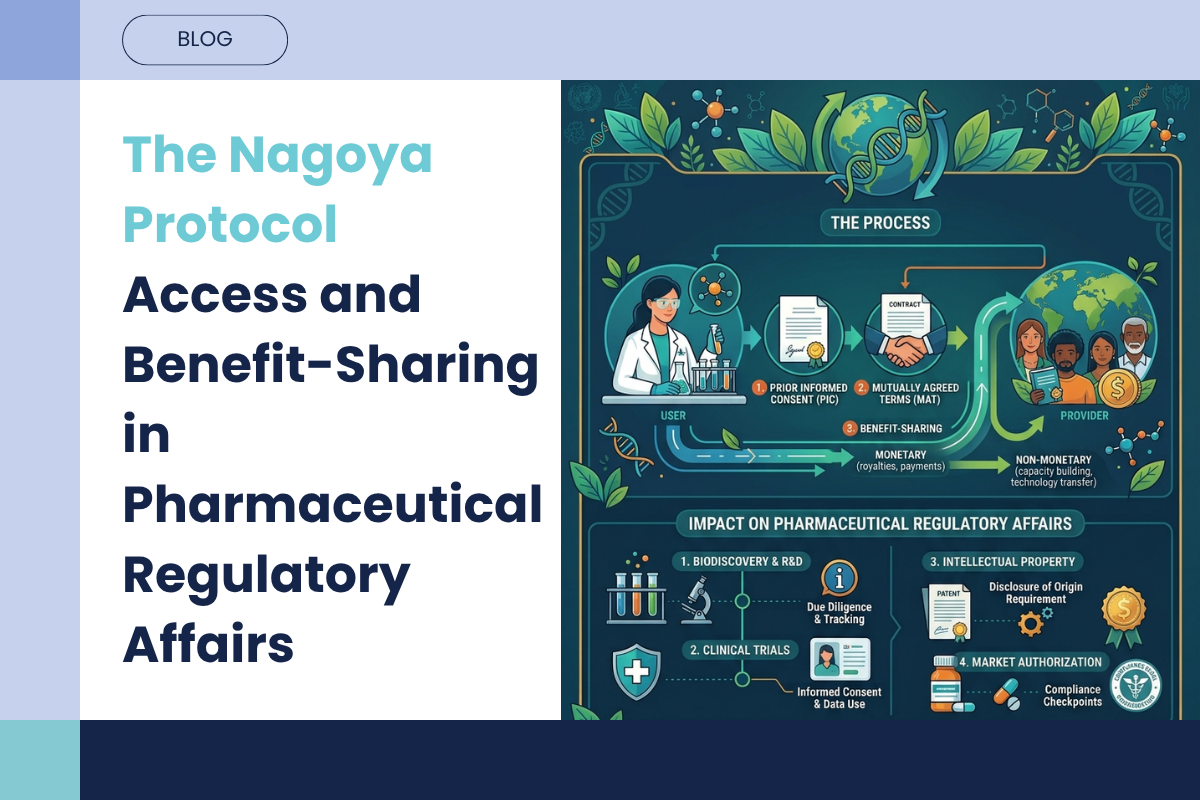
The Nagoya Protocol is an international agreement that governs how benefits arising from the use of genetic resources are shared between users and provider countries. It ensures that when biodiversity contributes to new products—such as medicines, vaccines, or cosmetics—the countries and communities conserving those resources are treated as partners rather than informal suppliers.
The Protocol applies when plants, animals, microbes, or other biological materials are used in research and development. It asks a simple but powerful question: when genetic resources lead to commercial or scientific value, how should benefits be shared, and under what terms?
Historically, valuable compounds were often sourced from biodiversity-rich regions with little consultation or compensation, a practice frequently described as unregulated bioprospecting. The Protocol aims to correct this by requiring prior informed consent (PIC) and mutually agreed terms (MAT) before access is granted, ensuring fair and equitable benefit sharing.
Legally, the Nagoya Protocol is a supplementary agreement to the Convention on Biological Diversity (CBD). Adopted in 2010 and in force since 2014, it provides a structured framework for implementing the CBD’s third objective: fair and equitable sharing of benefits arising from the utilization of genetic resources.
Why Nagoya Matters for Regulatory Dossiers
The Protocol itself does not create a specific CTD module. However, many “user countries” have implemented national laws requiring companies to demonstrate compliance when utilizing genetic resources.
For example, in the European Union, Regulation (EU) No 511/2014 requires companies to exercise due diligence and, at specific checkpoints, submit compliance declarations. These checkpoints may occur during research funding stages or prior to placing a product on the market.
In practice, by the time a marketing authorisation is filed, companies may need to confirm that all relevant biological materials were accessed lawfully and under agreed benefit-sharing terms. Regulatory Affairs teams must therefore ensure that compliance documentation exists, even if it is not physically included in the CTD.
Impact on Dossier Content and Supporting Documentation
Although Nagoya does not introduce a new CTD section, it significantly influences supporting documentation behind the dossier. Three areas are particularly affected:
- Traceability of Biological Starting Materials
Companies must be able to trace the origin of non-human genetic materials used in research, development, or manufacturing. This includes documenting:
- Country of origin
- Date of access
- Conditions of authorization
- Applicable national ABS legislation
This traceability may influence Module 3 descriptions of biological starting materials, cell banks, microbial strains, or botanical sources.
- Evidence of Lawful Access and Benefit Sharing
Companies may need to hold:
- Prior Informed Consent (PIC) documentation
- Mutually Agreed Terms (MAT) agreements
- National permits
- Internationally Recognized Certificates of Compliance (IRCC), where applicable
These are typically retained in internal compliance files rather than submitted publicly, but they underpin any due diligence declaration provided to authorities.
- Due Diligence and Compliance Declarations
Under EU rules and similar systems elsewhere, applicants must submit formal declarations confirming compliance. Regulatory teams must coordinate with R&D, sourcing, legal, and quality departments to ensure declarations are accurate and supported by a complete paper trail.
Impact on CMC: Traceability and Technical Alignment
Nagoya requirements indirectly influence Chemistry, Manufacturing and Controls (CMC) documentation. Module 3 must align with internal ABS records where biological materials are involved.
For example:
- If a microbial strain is used to produce a biologically derived intermediate, its origin and authorization status must be documented.
- If a plant extract contributes to synthesis or purification, sourcing must comply with provider country ABS laws.
Authorities may review ABS traceability during dossier assessment, GMP inspections, or post-authorisation audits. Therefore, CMC narratives must be consistent with internal ABS compliance files.
Compliance Risks and Regulatory Consequences
In several jurisdictions, ABS compliance is linked to market access conditions. Authorities may request evidence of lawful access during review or inspection.
Consequences of non-compliance can include:
- Regulatory deficiencies and approval delays
- Administrative fines
- Suspension of product placement
- Reputational damage
- Potential disputes affecting intellectual property or supply chains
Gaps identified late in development are difficult and costly to remediate. Early ABS assessment is therefore critical.
Regulatory Strategy and Timeline Considerations
From a strategic standpoint, Nagoya compliance is most efficient when addressed at lead identification or preclinical stages. If ABS status is unclear late in development, companies may face:
- Additional permit applications
- Renegotiation of benefit-sharing agreements
- Internal compliance investigations
- Delayed submissions
Funding bodies and authorities may conduct targeted audits of ABS systems, reviewing due diligence procedures and documentation. Even if non-compliance does not immediately block approval, it may raise concerns about the legality of continued manufacture and supply.
Integrating Nagoya into Regulatory and Quality Systems
A proactive approach integrates ABS compliance into broader regulatory and quality frameworks.
Key elements include:
- Early confirmation of provider country ABS requirements
- Securing necessary permits before R&D begins
- Recording collection dates, geographic origin, and authorization terms
- Maintaining central ABS registers
- Updating documentation when suppliers, processes, or legislation change
- Aligning Module 3, Module 1 administrative documentation, and GMP files
Regulatory Affairs must ensure consistency across submissions and be prepared for EU due diligence declarations or analogous checks in other regions.
Implications for the Cosmetics Sector
The cosmetics industry is particularly exposed to Nagoya obligations due to its reliance on plant, marine, and microbial ingredients, as well as associated traditional knowledge.
When natural ingredients are used in research and development to create new actives or support marketing claims, this typically qualifies as “utilization” under the Protocol. Companies must therefore assess both provider-country and user-country obligations.
Emerging Trends and Best Practices
Enforcement of Nagoya-related laws is intensifying. European authorities have increased scrutiny of corporate due diligence systems and, in some cases, imposed fines for non-compliance.
In response, leading organisations are shifting from project-specific checks to integrated ABS compliance frameworks. Best practices include:
- Corporate ABS policies
- Standard PIC/MAT contractual clauses
- Centralized ABS documentation systems
- Cross-functional training for R&D and procurement teams
- Alignment with sustainability and ESG initiatives
This evolution reflects a broader shift: Nagoya compliance is no longer a niche legal issue but a core regulatory and governance consideration across pharmaceuticals, biotech, food, and cosmetics.
Conclusion: The Future of Nagoya Compliance
The Nagoya Protocol has transformed biodiversity protection into a concrete regulatory expectation affecting pharmaceutical R&D, manufacturing, and market access throughout the product lifecycle.
For Regulatory Affairs and CMC teams, embedding ABS requirements into standard processes is essential to ensure lawful access, robust traceability, and resilient supply chains. When addressed proactively, Nagoya compliance not only reduces regulatory and reputational risk but also supports ethical innovation and fair partnerships with biodiversity-rich regions and indigenous communities.
In an era of heightened scrutiny on sustainability and responsible sourcing, strong ABS governance is becoming a hallmark of credible, future-ready life sciences organisations.
How Celegence Can Support
Celegence helps pharmaceutical, biotechnology, and life sciences organizations navigate the evolving regulatory requirements associated with the Nagoya Protocol and Access and Benefit-Sharing (ABS). Our multidisciplinary teams support companies in integrating ABS considerations into regulatory, CMC, and quality processes throughout the product lifecycle.
By combining regulatory expertise with structured compliance processes, Celegence helps organizations strengthen responsible sourcing practices, reduce regulatory risk, and support compliant global product development.
To learn more, contact us at info@celegence.com.
AUTHORED BY

Associate II, Technical Writing
Yeragonda Chandrakala

Other Related Articles

26 Jun, 2026

05 Jun, 2026
07 May, 2026
10 Apr, 2026