Companion Diagnostic Studies Under IVDR: Regulatory Requirements, Study Design, and Clinical Evidence Generation
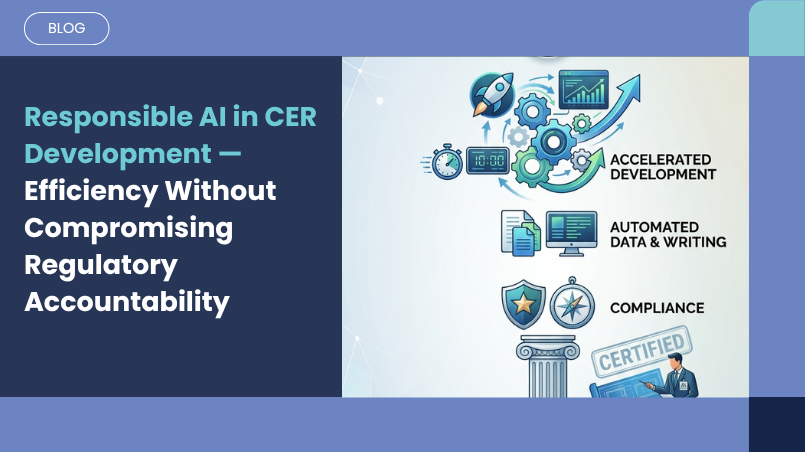
Responsible Integration of Artificial Intelligence in Clinical Evaluation Reports
21 Jul, 2026
Introduction
Clinical Evaluation Reports (CERs) have never been more demanding to produce. Since the EU Medical Device Regulation (Regulation (EU) 2017/745, “EU MDR”) became fully applicable, manufacturers have faced a stricter, more clinically rigorous standard for demonstrating that a device’s benefits outweigh its risks—a standard that applies to every device class, from Class I through Class III, throughout the entire product lifecycle. Regulatory Affairs professionals, Clinical Evaluation specialists, and medical writers are now expected to synthesize larger volumes of clinical literature, maintain continuous state-of-the-art surveillance, and produce audit-ready documentation, often with the same headcount they had a decade ago.
At the same time, market access timelines have not gotten more forgiving. Notified Bodies scrutinize CERs closely at every certification and renewal cycle, and gaps in literature search methodology, equivalence justification, or evaluator qualification are among the most common reasons submissions are sent back for rework. Manufacturers are caught between two pressures that pull in opposite directions: faster turnaround and deeper scientific rigor.
Artificial intelligence has entered this picture as a genuine opportunity—not to replace the expert, but to augment the expert. Yet the same technology that accelerates CER development can also undermine the very evidence it is supposed to strengthen if used without appropriate controls. AI can improve efficiency, but regulatory compliance still depends on human judgment, scientific rigor, and documentation that remains fully traceable and defensible. Used carelessly, it introduces exactly the kind of risk that a regulated document can least afford. This is a distinction every organization exploring AI-enabled CER development needs to understand clearly before it invests in the technology.
Why CER Development Is Becoming Increasingly Complex
Several converging factors explain why clinical evaluation has become one of the more resource-intensive parts of the technical file.
Legal obligation now applies to every device class. Article 61 of the EU MDR and Annex XIV Part A require manufacturers to plan, conduct, and document a clinical evaluation as a defined, methodologically sound procedure—a requirement that no longer has the lighter-touch exceptions that existed under the old Medical Device Directive.
Literature surveillance is continuous, not episodic. MEDDEV 2.7/1 Rev. 4 remains the primary methodological reference for how to run the literature search, appraise data quality, and structure the CER itself, and several MDCG guidance documents explicitly build on it—MDCG 2020-6, for example, maps which sections of the MEDDEV remain relevant under the MDR. A Clinical Evaluation Report (CER) produced once and filed away is no longer compliant; the clinical evaluation plan and its supporting evidence must be revisited as post-market surveillance (PMS) and post-market clinical follow-up (PMCF) data accumulate.
Equivalence has become harder to claim. Where a manufacturer relies on data from an equivalent device rather than its own clinical investigation, MDCG 2020-5 and MEDDEV 2.7/1 Rev. 4 both demand a much more detailed technical, clinical, and biological comparison than was historically expected, and the equivalent device generally needs to be CE-marked and accessible under contractual data-sharing arrangements.
PMCF is now an active feedback loop. Annex XIV Part B requires a PMCF plan and, where relevant, a PMCF evaluation report that feeds directly back into the CER, the risk management file, and any necessary corrective actions—turning clinical evaluation into a continuously updated, cross-referenced body of documentation rather than a single deliverable.
Reviewer expectations keep rising. Notified Bodies increasingly flag CERs where evaluators lack the clinical specialty relevant to the device’s indication, or where the search strategy relied on a single database such as PubMed without the broader European coverage that Rev. 4 expects from sources like Embase.
Manually keeping pace with all of this, across a growing device portfolio, is where traditional processes start to strain.
Where AI Adds Value in CER Development
Used within clear boundaries, AI language models and automation tools can meaningfully accelerate several stages of clinical evaluation:
- Literature search support — running structured queries across databases, applying inclusion/exclusion criteria consistently, and flagging duplicates.
- Abstract screening — triaging large literature sets so that human reviewers spend their time on genuinely relevant studies.
- Data extraction — pulling structured data points (study design, population, outcomes, adverse events) from full-text articles into standardized templates.
- Evidence organization — mapping extracted data against General Safety and Performance Requirements (GSPRs) and clinical claims.
- Summarization — producing first-pass narrative summaries of individual studies for expert review.
- Draft generation — assembling a structured first draft of sections such as device description, state-of-the-art background, or literature review methodology.
- Consistency verification — checking that claims, device descriptions, and referenced data align across the CER, the risk management file, and the instructions for use.
- Traceability support — linking each conclusion back to its underlying source, which is exactly the kind of bookkeeping that benefits from automation.
In a well-governed workflow, an AI system might screen several thousand abstracts overnight, present a shortlist with its reasoning, and hand that shortlist to a qualified clinical evaluator who makes the actual inclusion decisions. Or it might generate a first-draft literature summary that a medical writer then rewrites, verifies against source, and integrates into the report. In both cases, the AI compresses the mechanical, high-volume work; the human retains ownership of every substantive judgment.
Risks of Uncontrolled AI Usage
The same generative capabilities that make AI useful for drafting also make it capable of producing convincing but inaccurate output. Left ungoverned, this creates risks that go directly to the integrity of a regulated document:
- Hallucinated or fabricated references — AI language models can generate citations that look plausible but do not correspond to real studies or misattribute findings to the wrong source.
- Incorrect scientific interpretation — a model may misread study design, conflate correlation with causation, or misstate a safety finding.
- Loss of traceability — if AI-assisted edits are not logged, it becomes difficult to reconstruct how a conclusion was reached, undermining the audit trail a Notified Body will expect to see.
- Confidentiality and data protection exposure — feeding proprietary clinical data, unpublished study results, or personal data into a public or poorly governed AI tool can create GDPR compliance issues and intellectual property exposure.
- Bias in literature selection or summarization — models trained predominantly on certain data sources may systematically under-represent relevant regional or population-specific evidence.
- Lack of transparency — where an organization cannot explain what an AI tool did, on what data, and under what human oversight, it cannot substantiate the CER’s methodology if challenged.
None of these risks are hypothetical concerns unique to healthcare documentation; they are the well-documented limitations of current generative AI systems generally. What makes them consequential here is the context: a CER is a regulatory instrument that supports conformity assessment and, ultimately, patient safety. Unverified AI output has no place in that document. This is precisely why every AI-assisted output must undergo qualified human review before it is accepted into the CER, and why AI must never be permitted to independently reach clinical conclusions or make safety and performance determinations—those remain, unambiguously, matters of expert scientific and regulatory judgment.
Regulatory and Compliance Considerations
Responsible AI use in CER development doesn’t sit outside existing compliance frameworks; it needs to be built on top of them.
The EU AI Act (Regulation (EU) 2024/1689) introduces a risk-based framework for AI systems generally. It is worth being precise about scope here: AI that is embedded in, or functions as a safety component of, a medical device requiring Notified Body conformity assessment is automatically treated as high-risk under the Act, layering additional obligations—data governance, record-keeping, transparency, human oversight—on top of MDR requirements, with core obligations phasing in from August 2026 and an extended transition to August 2027 for devices already regulated under the MDR. A general-purpose AI tool used internally to support literature screening or drafting is a different use case from an AI-enabled device, but the AI Act’s underlying principles—data governance, transparency, human oversight, and documented risk management—represent good practice regardless of which category applies, and organizations should track how the Commission’s implementing guidance continues to develop.
GDPR governs any processing of personal data, and clinical literature or study data can contain personal or sensitive information. Any AI tool used in CER workflows needs contractual and technical safeguards—data processing agreements, access controls, and, wherever feasible, anonymization—before clinical data is exposed to it.
ISO/IEC 27001 provides the established framework for information security management, and it remains directly relevant to how an organization controls access to proprietary clinical data, manuscripts, and AI tool logs.
ISO/IEC 42001:2023, published in December 2023 as the first international standard dedicated to AI management systems, gives organizations a structured way to govern the development, provision, or use of AI—covering roles and responsibilities, risk assessment, data governance, and continual monitoring. Aligning an AI-assisted CER workflow with ISO 42001 principles is one of the clearest ways to demonstrate that AI governance is a managed system, not an informal practice.
ISO 13485, ISO 14971, and ISO 14155 continue to govern quality management, risk management, and clinical investigations respectively, and none of these obligations are diminished by the introduction of AI tools into the workflow.
These frameworks are complementary rather than competing: MDR and MEDDEV define what a compliant clinical evaluation must contain; ISO 42001 and ISO 27001 define how AI and data are governed and secured; the EU AI Act and GDPR define the legal guardrails around AI use and personal data. An organization that treats these as one integrated compliance architecture, rather than four separate checklists, is far better positioned than one addressing them piecemeal.
Responsible AI Model for CER Development
Literature Search
↓
AI Screening
↓
Human Review
↓
Evidence Extraction
↓
AI Draft
↓
Medical Writer Review
↓
Clinical Expert Review
↓
Final CER
A defensible AI-assisted CER workflow rests on ten interlocking controls:
- Human-in-the-loop review — every AI-generated output is reviewed, corrected, and approved by a qualified clinical evaluator or medical writer before inclusion.
- AI governance policy — a documented, board-level policy defining what AI tools may be used, for which tasks, and under what constraints.
- Information security controls — access management, encryption, and vendor due diligence aligned with ISO 27001.
- Validation of AI outputs — systematic checking of AI-generated summaries, extractions, and drafts against source documents.
- Scientific verification — independent confirmation that clinical interpretations and conclusions are scientifically sound.
- Source traceability — every citation and data point traceable back to its original, verifiable source.
- Version control — clear tracking of which sections were AI-assisted, which were human-authored, and how each version evolved.
- Audit trail — a documented record of AI tool usage, prompts, and reviewer decisions sufficient to withstand Notified Body scrutiny.
- Prompt governance — standardized, validated prompts for recurring tasks, reducing variability and unintended output.
- Continuous quality monitoring — periodic sampling and review of AI-assisted outputs to catch drift or emerging error patterns.
Picture this as two parallel tracks that converge before anything reaches the final document. On one track, AI performs the high-volume work—screening, extraction, first-draft summarization. On the other, a qualified human team defines scope, validates methodology, and holds ultimate authorship. The two tracks meet at a series of review checkpoints, and nothing crosses from the AI track into the final CER without passing through a human checkpoint first.
How CAPTIS® Supports the Responsible Integration of AI in Clinical Evaluation Reports
CAPTIS® is designed to support the responsible use of AI throughout the CER lifecycle by combining AI-powered efficiency gains with the controls, transparency, and oversight expected in regulated environments. Rather than replacing the medical writer, CAPTIS® uses a human-in-the-loop approach where AI assists with evidence-intensive tasks while qualified experts remain responsible for reviewing, validating, and approving all outputs.
The platform supports AI-assisted literature review, data extraction, evidence summarization, document interrogation, and first-draft generation, helping teams reduce manual effort associated with reviewing large volumes of clinical and technical documentation. AI can be used to identify relevant information, generate structured summaries, create tables, and assist with drafting specific content sections, enabling writers to focus their time on higher-value scientific and regulatory activities.
A key principle of responsible AI is transparency and traceability. CAPTIS® is designed to maintain connections between generated content and the underlying source evidence, allowing users to verify supporting information and maintain audit readiness. This traceability helps support regulatory defensibility by ensuring that conclusions and drafted content can be reviewed against the original literature, technical documentation, and other source materials.
Celegence also recognizes that not all CER activities are equally appropriate for automation. AI is particularly well suited for repetitive and evidence-driven tasks such as literature analysis, information extraction, and draft generation, while activities requiring clinical judgment, benefit-risk assessment, equivalence determination, and final regulatory conclusions remain under expert control. This risk-based approach helps organizations maximize efficiency while maintaining scientific rigor and accountability.
To further support responsible adoption, CAPTIS® operates within a framework that emphasizes validation, review, governance, and data security. AI-generated outputs are intended to support decision-making rather than replace it, and organizations can apply their existing quality and review procedures before content is incorporated into regulatory deliverables. Additionally, enterprise-grade security controls and governance practices help ensure that customer data remains protected throughout the process.
Ultimately, CAPTIS® enables regulatory and clinical teams to leverage AI in a manner that improves efficiency, consistency, and scalability while preserving the human oversight, traceability, transparency, and regulatory accountability required for Clinical Evaluation Reports.
Why Expert Consultancy Matters
Governance frameworks are only as good as the people applying them. This is where experienced regulatory and clinical evaluation consultants add value that a tool alone cannot replicate:
- Scientific and clinical expertise to correctly interpret study findings and benefit-risk profiles.
- Regulatory interpretation of evolving MDCG guidance and Notified Body expectations.
- Critical appraisal skills to judge the methodological quality of clinical literature.
- Compliance assurance across MDR, ISO standards, and AI governance requirements simultaneously.
- Risk management integration between the CER and the broader technical file.
- Independent quality review, including the declarations of interest and evaluator qualifications Notified Bodies now scrutinize closely.
- Faster delivery through governed AI workflows that combine automation with rigorous oversight rather than extremes.
- Consistent, audit-ready documentation that anticipates the questions a reviewer will ask.
For manufacturers, the calculation is straightforward: adopting AI without this layer of expertise introduces the exact risks outlined above, while forgoing AI altogether leaves teams unable to keep pace with the volume of literature and documentation MDR now demands. A consultancy that has already built its AI governance model around human oversight, traceability, and validated workflows offers a way to capture the efficiency gains of AI without inheriting its risks—with the accountability of experienced regulatory professionals standing behind every conclusion in the report.
Conclusion
Artificial intelligence is reshaping the way regulatory and clinical teams approach Clinical Evaluation Report development. As evidence volumes continue to grow and regulatory expectations become increasingly rigorous, organizations are looking for smarter ways to manage complexity without compromising quality. AI offers a powerful opportunity to improve efficiency, streamline evidence-intensive activities, and reduce the administrative burden associated with clinical evaluation. However, its true value lies not in replacing expertise, but in enabling experts to focus on the work that matters most.
At its core, clinical evaluation remains a scientific and regulatory exercise that depends on experience, critical thinking, and professional judgment. No algorithm can fully replace the expertise required to assess clinical relevance, interpret evidence, establish benefit-risk conclusions, or defend regulatory decisions during review. These responsibilities will continue to rest with qualified clinical evaluators, medical writers, and regulatory professionals.
The organizations that stand to benefit most from AI will be those that embrace it thoughtfully and responsibly. By combining AI-driven efficiencies with strong governance, robust validation, complete traceability, and meaningful human oversight, manufacturers can create more scalable and sustainable clinical evaluation processes without sacrificing compliance or scientific integrity.
Ultimately, the future of CER development is not a choice between humans and AI. It is a partnership where technology helps regulatory and clinical professionals work more efficiently, while human expertise ensures every conclusion remains accurate, transparent, and defensible. When implemented within the right framework, AI becomes more than a productivity tool—it becomes a catalyst for smarter, more effective clinical evaluation.
Contact us at info@celegence.com to learn more about CAPTIS® and our MDR compliance services.
AUTHORED BY

Associate Manager - Medical Device Services
Abhay Sajeev Nair

Other Related Articles
17 Jun, 2026
13 May, 2026
29 Apr, 2026

22 Apr, 2026
18 Mar, 2026