Predictable CMC Costs Over Multi-Year Programs: Why Partnership Beats Project-by-Project Outsourcing
Human Expertise at Scale: Why the Future of CMC Is AI-Assisted, Expert-Led
03 Sep, 2026
Introduction
Chemistry, Manufacturing, and Controls (CMC) sits at the heart of pharmaceutical development. It is where scientific knowledge, process understanding, manufacturing capability, analytical rigor, and regulatory expectations come together to turn a promising molecule into a product that can be manufactured consistently and safely.
Yet modern CMC Consulting organizations face a growing challenge: the volume and complexity of CMC work are increasing faster than expert capacity.
Teams must evaluate larger datasets, manage increasingly complex manufacturing processes, prepare extensive regulatory documentation, investigate deviations, compare analytical results, and make decisions under demanding timelines. At the same time, experienced CMC professionals remain a finite resource.
This is where artificial intelligence can make a fundamental difference.
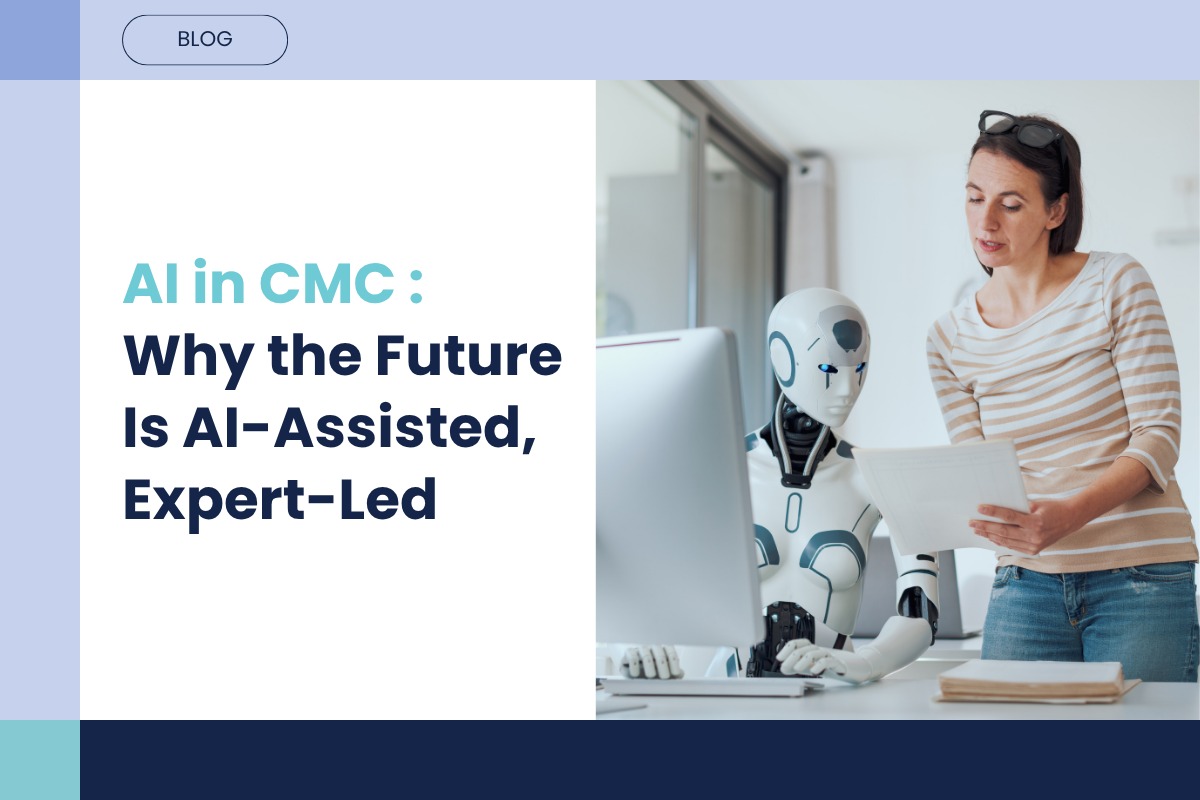
The future of CMC is unlikely to be fully autonomous. Instead, it will be AI-assisted and expert-led—a model in which AI handles scale, speed, pattern recognition, and information processing, while experienced scientists and engineers provide judgment, context, accountability, and scientific leadership.
The goal is not to replace expertise. It is to multiply it.
The CMC Capacity Challenge
CMC development generates an enormous amount of information across the product lifecycle. Data may come from process development, analytical development, formulation studies, stability programs, manufacturing batches, laboratory investigations, quality systems, and regulatory submissions.
Traditionally, experts have been responsible for reviewing this information, identifying relevant signals, connecting disparate findings, and translating them into decisions.
That model becomes increasingly difficult as organizations scale.
A subject-matter expert can only review so many documents, investigate so many deviations, analyze so many trends, and participate in so many technical discussions. Adding more people can help, but it does not always solve the underlying problem. Recruiting and developing experienced CMC professionals takes time, and critical expertise may remain concentrated in a relatively small number of individuals.
AI introduces another possibility: scale without proportionally increasing the workload of experts.
AI as a Force Multiplier for CMC Experts
The most valuable role for AI in CMC is not simply automation. It is augmentation.
An AI-enabled CMC environment can help experts rapidly search and synthesize information, identify relationships across datasets, summarize technical documents, flag anomalies, compare process parameters, and surface potentially relevant knowledge.
For example, instead of an expert spending hours manually reviewing hundreds of pages of development reports, an AI system could identify relevant sections, summarize key findings, and highlight inconsistencies or changes that warrant closer examination.
The expert remains responsible for determining what those findings actually mean.
This distinction is critical.
AI can answer questions such as:
- What information is present?
- What patterns appear in the data?
- Which documents contain relevant evidence?
- What has changed over time?
- Which variables appear correlated?
- What areas may require further investigation?
But experienced CMC professionals are needed to answer the higher-value questions:
- Is the pattern scientifically meaningful?
- Is the evidence sufficient to support a conclusion?
- What are the potential risks?
- What additional experiments are required?
- How should the finding influence the control strategy?
- What will regulators expect to see?
- What decision is appropriate given the broader product context?
AI can accelerate analysis. Expertise provides judgment.
From Knowledge Retrieval to Knowledge Orchestration
One of the most promising applications of AI in CMC is connecting information that traditionally exists in separate systems and organizational silos.
CMC knowledge can be fragmented across reports, laboratory systems, manufacturing records, specifications, protocols, investigations, databases, spreadsheets, and regulatory documents.
An AI-enabled knowledge layer can help connect these sources.
Imagine an expert investigating an unexpected change in a critical quality attribute. Rather than manually searching through historical batch records, development reports, analytical studies, and investigation documents, the expert could ask an AI system to identify relevant historical events and summarize potential relationships.
The system might reveal that similar observations occurred during an earlier development phase or under a particular combination of process conditions.
That does not automatically establish causality. But it gives the expert a much faster route to the evidence required to investigate the question.
This represents a shift from information retrieval to knowledge orchestration.
AI becomes a research partner that helps experts navigate the organization’s accumulated knowledge.
AI Can Help Democratize Expertise—Without Diluting It
Another important benefit is the ability to make specialized knowledge more accessible across CMC organizations.
Large organizations often have highly experienced individuals whose knowledge has been built over decades. Much of that knowledge may exist informally—in personal notes, previous projects, conversations, decision rationales, and experience with specific processes.
When those experts are unavailable, less experienced team members may struggle to reproduce the same reasoning.
AI can help capture and contextualize organizational knowledge.
A well-designed system could guide a scientist toward relevant historical decisions, explain why certain approaches were previously selected, surface applicable procedures, and identify the experts associated with particular areas of knowledge.
This does not mean converting expert judgment into a collection of simplistic rules.
Instead, AI can create a knowledge multiplier, helping more people access the right information while preserving expert oversight for consequential decisions.
The Human-in-the-Loop Model
For regulated industries, human oversight is not an optional feature. It is fundamental.
CMC decisions can influence product quality, patient safety, manufacturing consistency, and regulatory commitments. Consequently, AI-generated outputs should not automatically become final scientific or quality decisions.
The strongest model is therefore human-in-the-loop.
In this model:
AI performs the heavy lifting. It processes information, identifies patterns, summarizes evidence, monitors trends, and proposes potential areas of attention.
Experts perform the critical thinking. They challenge assumptions, assess evidence, interpret results, evaluate risk, and make or approve decisions.
Governance provides the guardrails. Organizations establish appropriate validation, access controls, documentation, auditability, data governance, and accountability.
This creates a system in which AI increases productivity without eliminating responsibility.
What AI-Assisted, Expert-Led CMC Could Look Like
Consider a CMC development team preparing for a major regulatory milestone.
In a traditional workflow, experts might spend substantial time gathering information from different sources, reconciling data, preparing summaries, reviewing documents, and responding to repetitive questions.
In an AI-assisted workflow, much of that preparation could happen continuously.
AI could:
- Monitor incoming development and manufacturing data.
- Identify unusual trends or potential inconsistencies.
- Organize evidence around key CMC questions.
- Summarize relevant historical information.
- Compare current results with previous development knowledge.
- Draft preliminary technical summaries.
- Identify gaps that may require additional evidence.
- Route high-priority questions to the appropriate experts.
The CMC professional then focuses more of their time on scientific interpretation, risk assessment, strategy, and decision-making.
The result is not fewer experts.
It is more expert-level work performed per expert.
The Importance of Trust and Explainability
Scaling AI across CMC requires more than technical performance.
Scientists and engineers need to understand why an AI system produced a particular recommendation or identified a particular pattern. If the system cannot provide sufficient evidence or traceability, experts may be unable—or unwilling—to rely on its output.
Trust therefore becomes a design requirement.
AI systems used in CMC should ideally support:
- Traceable source information
- Clear evidence behind generated insights
- Appropriate confidence indicators
- Version and data lineage
- Audit trails
- Defined human approval points
- Strong access and data controls
- Continuous monitoring of system performance
The objective is not to make AI infallible. It is to make AI transparent enough to be challenged.
That is particularly important in regulated environments, where being able to explain how a conclusion was reached can be as important as the conclusion itself.
The Future CMC Workforce
AI will also change what it means to be a CMC expert.
Technical expertise will remain essential, but future leaders will increasingly need to combine scientific knowledge with data literacy and AI fluency.
CMC professionals may need to understand how to:
- Evaluate AI-generated insights
- Formulate effective analytical questions
- Recognize model limitations
- Validate AI-supported workflows
- Interpret complex datasets
- Challenge algorithmic conclusions
- Establish appropriate governance
- Integrate AI into scientific decision-making
At the same time, organizations will need to invest in people.
AI adoption should not be viewed purely as a technology deployment. It is a workforce transformation initiative.
The organizations that benefit most will be those that teach their experts how to work effectively with AI rather than simply asking AI to perform existing workflows faster.
From Automation to Augmentation
There is an important difference between automation and augmentation.
Automation asks: “How can we make this task happen without a person?”
Augmentation asks: “How can we help this expert accomplish more, faster, and with better information?”
For CMC, augmentation is often the more powerful question.
Scientific development contains ambiguity, trade-offs, incomplete evidence, and context-dependent decisions. These are precisely the areas where human expertise remains indispensable.
AI is exceptionally good at scale. Humans remain essential for meaning.
The combination can be considerably more powerful than either alone.
Building the AI-Assisted CMC Organization
Organizations looking to adopt this model should begin with high-value, well-defined use cases rather than attempting to transform every CMC workflow simultaneously.
Potential starting points include:
- Technical document intelligence
- Regulatory content review
- Knowledge search and retrieval
- Process trend analysis
- Analytical data review
- Change impact assessment
- CMC data summarization
- Knowledge management
- Scientific literature monitoring
The focus should be on workflows where AI can reduce repetitive effort while leaving meaningful scientific decisions with qualified experts.
Organizations should also establish governance from the beginning. Data quality, model validation, cybersecurity, intellectual property, regulatory expectations, and human accountability must be considered alongside productivity gains.
The Competitive Advantage: Expertise at Scale
The biggest strategic advantage of AI in CMC may ultimately be neither cost reduction nor faster document generation.
It may be expertise at scale.
An organization that enables its most experienced scientists and engineers to work with AI can potentially extend the reach of their knowledge across more programs, datasets, manufacturing sites, and development teams.
Instead of an expert answering one question at a time, AI can help that expert support dozens of investigations, identify patterns across years of historical information, and provide context to teams across the organization.
This creates a new productivity model:
More data + more AI capability + stronger human judgment = greater scientific capacity.
Conclusion
The future of CMC won’t be defined by humans versus AI — it will be defined by how well the two are combined. AI brings speed, scale, and pattern recognition; human experts bring judgment, context, and accountability. That combination is exactly what Celegence delivers: AI-assisted, expert-led CMC, where technology handles the volume so our regulatory scientists can focus on the decisions that matter most.
The strongest CMC partners in the years ahead won’t be the ones with the most AI or the biggest teams — they’ll be the ones who’ve built the best partnership between human expertise and intelligent systems. That’s the partnership Celegence offers: turning limited expert capacity into scalable scientific capability for every client we serve.
Scale Expertise, Not Just Automation
The future of CMC isn’t about removing experts from the process. It’s about enabling experienced scientists and regulatory professionals to spend more time on the work where their expertise creates the greatest value.
By combining regulatory and CMC expertise with AI-enabled workflows, Celegence helps organizations manage growing information volumes, accelerate knowledge retrieval and content development, and support more efficient CMC decision-making – while keeping scientific judgment and accountability with qualified experts.
The outcome is not fewer experts. It is more expert-level work performed per expert, which is the central productivity model developed throughout the article.
AUTHORED BY

Team Lead - Regulatory Affairs
Gyanendra Singh

Other Related Articles

26 Aug, 2026
25 Aug, 2026
20 Aug, 2026
19 Aug, 2026
06 Aug, 2026