
How to Address Data Consistency Challenges in EU MDR Submissions: A CAPTIS® Perspective
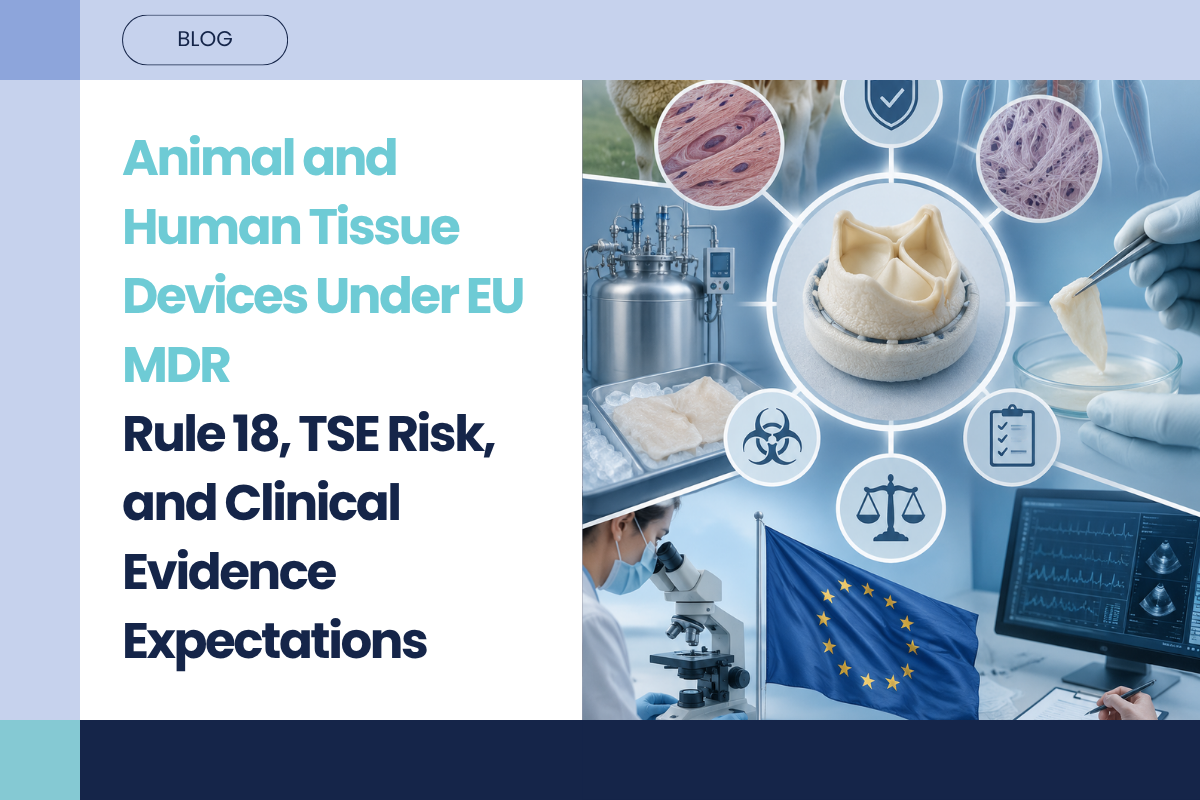
Devices Incorporating Tissues or Cells of Animal or Human Origin, or Their Derivatives: Data Expectations Under EU MDR
13 May, 2026
The EU Medical Device Regulation (EU MDR 2017/745) sets stringent requirements for medical devices incorporating tissues or cells of animal or human origin, or their derivatives. These devices such as bovine collagen-based products, porcine heart valves, xenografts, and human tissue-derived materials present unique biological and safety risks that require a robust regulatory strategy throughout the product lifecycle.
For manufacturers of such devices, understanding the precise scope of the EU MDR’s requirements and the data expectations associated with them is no longer optional. It is the foundation of CE certification and continued market access.
Scope and Regulatory Boundaries Under EU MDR
EU MDR applies to devices manufactured using nonviable animal or human tissues, cells, or their derivatives. A critical consideration is whether the biological component has an ancillary or principal mode of action.
If the tissue or cell component has an ancillary function to the medical device, the product falls under EU MDR. However, if the biological component provides the principal intended action, different legislation such as Directive 2004/23/EC for human tissues may apply.
This distinction significantly impacts the applicable regulatory pathway and should be carefully justified within the technical documentation.
Classification: Rule 18 and Its Far-Reaching Implications
Under Annex VIII, Rule 18 of the EU MDR, devices utilizing nonviable or rendered nonviable tissues or cells of human or animal origin, or their derivatives, are generally classified as Class III devices, except those intended to contact intact skin only.
Importantly, the MDR broadens the scope through the term “utilizing,” meaning the biological material does not need to remain in the final device. Materials used during manufacturing may still trigger Rule 18 classification due to the potential presence of residual contaminants. Consequently, even animal-derived processing aids or excipients may bring a device within the scope of Class III classification.
This classification results in increased regulatory scrutiny, including mandatory Notified Body involvement, Technical Documentation Assessment, and, where applicable, consultation procedures under Regulation (EU) No 722/2012 for animal-derived materials.
The Role of Regulation (EU) No 722/2012 and the TSE Consultation Process
For devices utilizing tissues from Transmissible Spongiform Encephalopathy (TSE)-susceptible species such as bovine, ovine, caprine, deer, elk, mink, and cats, Regulation (EU) No 722/2012 introduces an additional consultation process alongside MDR conformity assessment.
The primary concerns include transmission of infectious agents, including TSE agents, viruses, and bacteria, as well as potential immunological or toxicological reactions. Manufacturers are therefore expected to demonstrate stringent sourcing controls and validated processes for the removal or inactivation of contaminants.
As part of the procedure, the Notified Body evaluates the technical documentation and prepares a Summary Evaluation Report (SER) assessing TSE-related risks and corresponding mitigation measures. The SER is reviewed by Competent Authorities before certification can be issued.
Under MDR, even starting materials supported by EDQM Certificates of Suitability, previously exempt under the MDD framework, are now subject to a mandatory though expedited consultation process. Notified Bodies also expect manufacturers to justify the specific clinical benefit of using tissues or derivatives from TSE-risk species, with clear supporting evidence included in the technical documentation.
Technical Documentation and Risk Management Data Requirements
Devices utilizing animal-derived tissues or derivatives require significantly more extensive technical documentation than conventional medical devices. Under EU MDR and Regulation (EU) No 722/2012, manufacturers must establish a comprehensive risk management strategy addressing risks associated with transmissible agents, including Transmissible Spongiform Encephalopathy (TSE).
Manufacturers are expected to justify the use of animal-derived materials, including the species, tissue source, and sourcing approach, while also evaluating potential alternatives such as synthetic or lower risk materials. High TSE infectivity tissues should only be used in exceptional cases where no suitable alternative exists and a clear patient benefit can be demonstrated.
In addition, manufacturers must implement stringent sourcing and traceability controls, supported by validated contaminant removal or inactivation processes. Compliance with the ISO 22442 series is generally expected to demonstrate conformity with relevant GSPRs, particularly those related to biological safety.
Clinical Evaluation Expectations
For Class III devices incorporating animal or human-derived materials, clinical evaluation must be conducted in accordance with Article 61 and Annex XIV (Part A) of the EU MDR as a continuous lifecycle activity. The Clinical Evaluation Plan (CEP) should specifically address benefit–risk considerations associated with the biological components and outline the clinical development strategy, including planned investigations, milestones, and acceptance criteria.
Equivalence claims for these devices are highly restricted under MDR, particularly for Class III and implantable devices. In most cases, manufacturers are expected to generate product-specific clinical evidence through clinical investigations and robust Post-Market Clinical Follow-up (PMCF) activities initiated early in the product lifecycle.
Post-Market Clinical Follow-Up (PMCF) and PMS Obligations
For Class III devices incorporating animal or human-derived materials, Post market Surveillance (PMS) and Post-Market Clinical Follow-up (PMCF) are critical regulatory expectations under EU MDR. Manufacturers are expected to establish a proactive PMS framework supported by a PMCF Plan and periodic PMCF Reports to continuously confirm the long-term safety, performance, and benefit–risk profile of the device.
Notified Bodies closely review PMCF commitments during certification and surveillance activities, and failure to implement planned PMCF activities may impact/delay CE certification status. In addition, manufacturers must continuously monitor risks associated with the biological materials used, including changes related to TSE risks, which may trigger additional consultation procedures.
For Class III devices, Periodic Safety Update Reports (PSURs) are mandatory and should incorporate PMCF findings, vigilance data, complaint trends, and updated literature to support ongoing clinical and regulatory compliance.
Practical Considerations
For devices incorporating non-viable human tissues or their derivatives, manufacturers must also comply with Directive 2004/23/EC requirements related to donation, procurement, testing, processing, storage, distribution, and traceability of source materials. Particular attention should be given to supplier qualification, tissue sourcing controls, and patient safety during tissue processing.
Manufacturers should additionally plan for EUDAMED registration and preparation of a Summary of Safety and Clinical Performance (SSCP) for Class III devices.
Given the complexity of these devices, early regulatory planning is critical. Manufacturers should establish a clear clinical and PMCF strategy, robust TSE risk management measures, validated sourcing and traceability systems, and close coordination with the Notified Body throughout development and conformity assessment activities. Ongoing monitoring of evolving scientific guidance related to TSE and zoonotic risks is also essential to maintain compliance under EU MDR and Regulation (EU) No 722/2012.
How Celegence Can Support
Celegence supports manufacturers of tissue-based and biologically derived medical devices with end-to-end regulatory, clinical, and compliance services aligned with EU MDR expectations. Our teams help organizations address complex requirements related to Rule 18 classification, TSE risk management, clinical evaluation, and lifecycle evidence generation.
By combining regulatory expertise with structured clinical and technical documentation approaches, Celegence helps manufacturers strengthen compliance while supporting efficient CE certification pathways. To learn more, contact us at info@celegence.com
AUTHORED BY

MANAGER/SENIOR SME, MEDICAL DEVICE SERVICES
Priya Ray Chaudhuri

Other Related Articles

29 Apr, 2026

22 Apr, 2026

18 Mar, 2026


08 Jan, 2026