
Technology Transfer in Pharma: Best Practices for Successful CMC and Regulatory Compliance
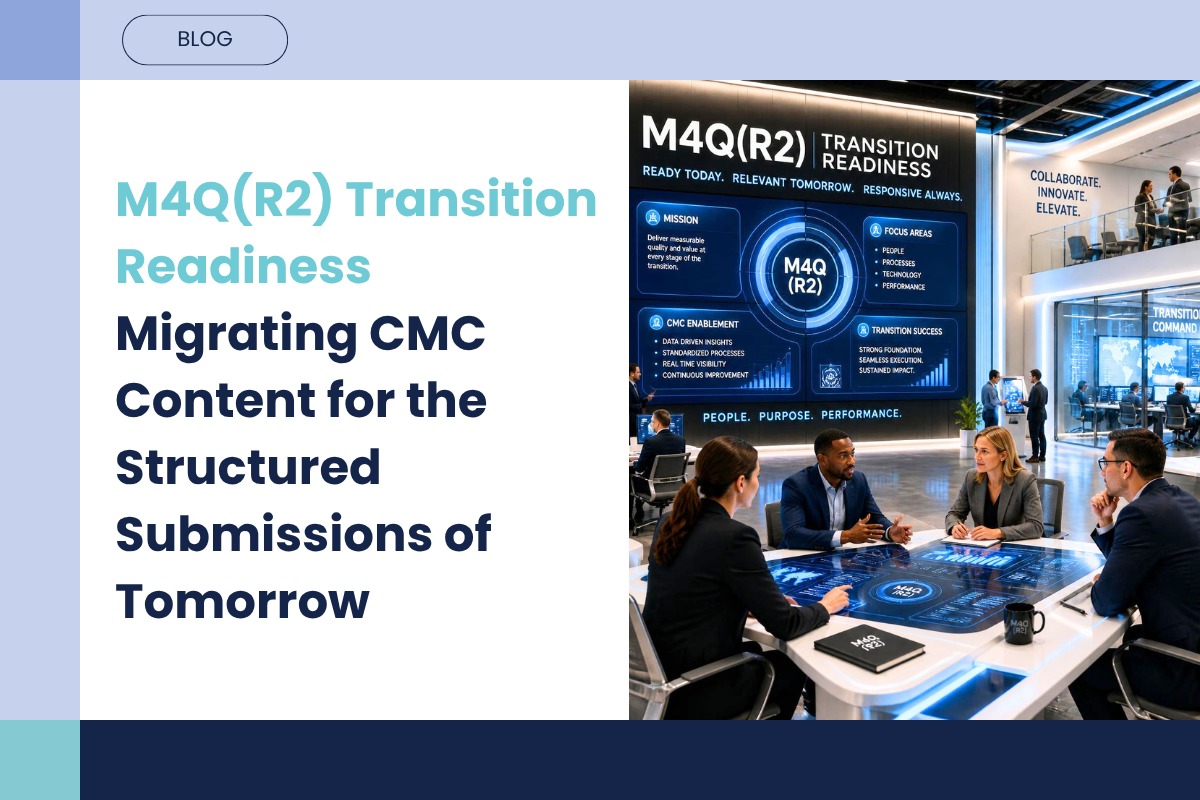
M4Q(R2) Transition Readiness: Migrating CMC Content for the Structured Submissions of Tomorrow
19 Aug, 2026
M4Q(R2) Readiness Is More Than a Template Update
M4Q(R2) readiness isn’t just about updating templates. It’s about making existing CMC information structured, traceable, reusable, and ready for lifecycle change.
For pharmaceutical organizations, preparing for ICH M4Q(R2) should not begin with a new document template. It should begin with a more fundamental question:
Is your existing CMC information ready for a more structured, lifecycle-driven regulatory environment?
The transition to M4Q(R2) represents a significant change in how quality information is organized, justified, maintained, and reused. For many companies, this creates a migration challenge because CMC knowledge is often distributed across dossiers, spreadsheets, source documents, manufacturing records, regulatory correspondence, variations, annual reports, and multiple versions of the same information.
The real task is therefore not simply rewriting Module 3. It is understanding what information already exists, whether it is consistent and traceable, what needs remediation, and how today’s content can support the more structured submissions of the future.
The Biggest Migration Challenge May Already Be in Your Existing Dossiers
Most organizations are not starting from scratch. They already manage years of CMC documentation covering:
- Multiple products, formulations and strengths
- Manufacturing and testing sites
- Regional and global submissions
- Variations, supplements and post approval changes
- Stability updates
- Specifications and analytical methods
- Health Authority responses
- Post-approval commitments and lifecycle activities
The challenge is that this content was typically created for a document-centric environment.
The same information may appear differently across Module 3 sections, Quality Overall Summaries, regional dossiers, source documents, and lifecycle submissions. Over time, small inconsistencies accumulate. A specification may be updated in one location but not another. A manufacturing description may vary across markets. An analytical method may change while older language remains elsewhere.
These differences already create regulatory risk. In a more structured environment, they become harder to manage.
M4Q(R2) readiness therefore starts with the quality of the information you already have, not simply the documents you plan to create next.
Step One: Understand What You Are Migrating
Before moving toward an M4Q(R2)-aligned model, companies need visibility into their current CMC content.
Key questions include:
Where is the authoritative information?
Teams should know which source represents the approved version of specifications, manufacturing processes, analytical procedures, stability information, and control strategies.
Where is content duplicated?
Repeated information across submissions and markets creates unnecessary review effort and increases the risk of inconsistencies.
Where are the gaps?
Differences in values, units, terminology, cross-references, or scientific justification can create issues during regulatory review.
Can every key statement be traced?
When a Health Authority challenges a statement, regulatory teams should be able to identify the source information quickly and confidently.
What information can be reused?
Validated CMC content should support future submissions and lifecycle activities rather than being recreated each time.
This is where a structured CMC gap assessment becomes especially important. The objective is not only to identify missing documents, but to determine whether the underlying information is complete, current, consistent, and reusable.
Move from Document Migration to Information Migration
One of the most important mindset changes is recognizing the difference between moving documents and migrating information.
Traditional migration projects often focus on files:
Where is the document? Which version is current? Where should it be stored?
Future-ready CMC operations require another level of thinking:
What information does the document contain? Where else does that information appear? Which source is authoritative? How is it connected to other regulatory content?
This matters because structured regulatory operations depend on information being maintained consistently across products, markets, and lifecycle events.
A stronger information model can improve:
- Content consistency
- Traceability
- Change impact assessment
- Lifecycle maintenance
- Cross-functional collaboration
- Structured Submission preparation
- Health Authority response readiness
The goal should not be to carry yesterday’s document problems into tomorrow’s regulatory environment.
The transition is an opportunity to fix them.
Build Traceability Before You Need It
Traceability becomes increasingly important as CMC information is reused across multiple regulatory activities.
Every important regulatory statement should have a defensible connection to its source information.
A useful model is:
Source → Data → Regulatory Content → Submission → Lifecycle Change
When these relationships are clear, teams can better understand what needs to change when the underlying information changes.
For example, a revised analytical method should not require teams to manually search multiple dossiers to identify every affected section. A connected information model makes it easier to determine where the method is referenced, evaluate regulatory impact, update the relevant content, and maintain consistency across subsequent submissions.
This is where M4Q(R2) readiness becomes an operational benefit, not just a compliance exercise.
Design for Lifecycle Reuse
Many organizations still approach CMC content development as a submission specific activity.
A dossier is authored, reviewed, submitted, and then effectively becomes static until another regulatory event requires an update.
That creates significant rework.
A more sustainable model is to design content for lifecycle reuse from the beginning.
Validated information should become the starting point for future activities such as:
- New strengths and dosage forms
- Manufacturing process changes
- Additional manufacturing sites
- Global expansion
- Post approval Variations and supplements
- Annual reports and renewals
- Health Authority questions
Every lifecycle update should build on prior regulatory knowledge rather than restart the authoring process.
This aligns closely with Celegence’s CMC positioning around structured content, lifecycle reuse, traceability, and maintaining one connected source of truth across regulatory activities.
Future-Readiness Goes Beyond M4Q(R2)
M4Q(R2) should also be viewed as part of a wider shift toward structured regulatory information.
For CMC teams, that means technology and content decisions made today should not solve only for the next dossier.
The more important question is:
Will the processes, governance, content structures, and technology we implement today remain useful as submissions become more structured and data-driven?
That is the difference between short-term compliance and long-term readiness.
Organizations should therefore focus on building content that is:
- Structured authoring
- Consistent
- Traceable
- Reusable
- Easy to maintain
- Supported by clear ownership
Five Questions to Assess Your M4Q(R2) Readiness
Regulatory and CMC leaders can start by asking:
- Can we identify our authoritative CMC information?
If teams cannot quickly determine what is current and approved, migration will be difficult. - How much duplication exists across our dossiers?
Repeated content increases maintenance effort and creates inconsistency risk. - Can important regulatory statements be traced to source information?
Traceability should be built into the process, not reconstructed after a regulatory query. - Can changes be propagated efficiently?
When specifications, analytical methods, manufacturing processes, or other quality information changes, teams should understand which regulatory documents are affected. - Are we building content for reuse?
Templates, authoring processes, and systems should support the lifecycle, not just the immediate submission.
Organizations that struggle with these questions may have more migration work ahead than expected.
AI Can Accelerate Migration, But Experts Still Own the Judgment
Migration and remediation involve significant manual effort. Teams may need to review thousands of pages, compare values, extract CMC data, reconcile terminology, identify potential gaps, and prepare updated content.
Purpose-built AI can accelerate these activities.
Celegence’s CMC model uses technology to support large-document review, unit and value reconciliation, drafting, and initial gap identification, while senior regulatory experts verify and own every output.
AI can help with:
- Data extraction
- Content comparison
- Initial gap identification
- Unit and value reconciliation
- Drafting support
- QC
- Traceability
- Content reuse
But scientific justification, regulatory interpretation, and final conclusions still require experienced professionals.
Don’t Wait Until Migration Becomes Urgent
Large CMC portfolios cannot be standardized overnight.
Reconciling inconsistent information, defining authoritative sources, improving traceability, establishing reusable structures, and changing authoring processes can require significant effort.
A practical transition approach is:
Assess → Rationalize → Structure → Validate → Reuse → Maintain
Starting early allows companies to prioritize high-risk areas and improve readiness gradually rather than treating M4Q(R2) as a last-minute remediation project.
Make M4Q(R2) a CMC Modernization Opportunity
M4Q(R2) gives pharmaceutical companies an opportunity to address a long-standing problem: regulatory information fragmented across documents, markets, systems, and teams.
The organizations best positioned for the transition will be those that look beyond template updates and rethink how CMC knowledge is maintained throughout the product lifecycle.
The objective is not simply to prepare the next dossier.
It is to create CMC information that is structured, traceable, reusable, human-validated, and ready for change.
We Deliver the Outcome
CMC documentation is complex. We make it manageable.
Celegence supports pharmaceutical companies across CMC strategy, gap assessment, Module 2.3 and Module 3 authoring, publishing, submissions, Health Authority responses, and lifecycle management and post approval submission. Our model combines senior regulatory expertise with AI-accelerated workflows, so technology takes on the repetitive work while experts retain ownership of regulatory judgment.
Whether you are assessing M4Q(R2) readiness, preparing existing CMC content for migration, or building a more structured and reusable documentation model, Celegence can help establish a practical path forward.
Contact info@celegence.com to discuss your M4Q(R2) transition and CMC documentation strategy.
Other Related Articles
04 Aug, 2026
15 Jul, 2026
02 Jul, 2026

26 Jun, 2026

05 Jun, 2026