

AI-Enabled Clinical Evaluation Reports (CERs): Ensuring Predictable Costs Year After Year
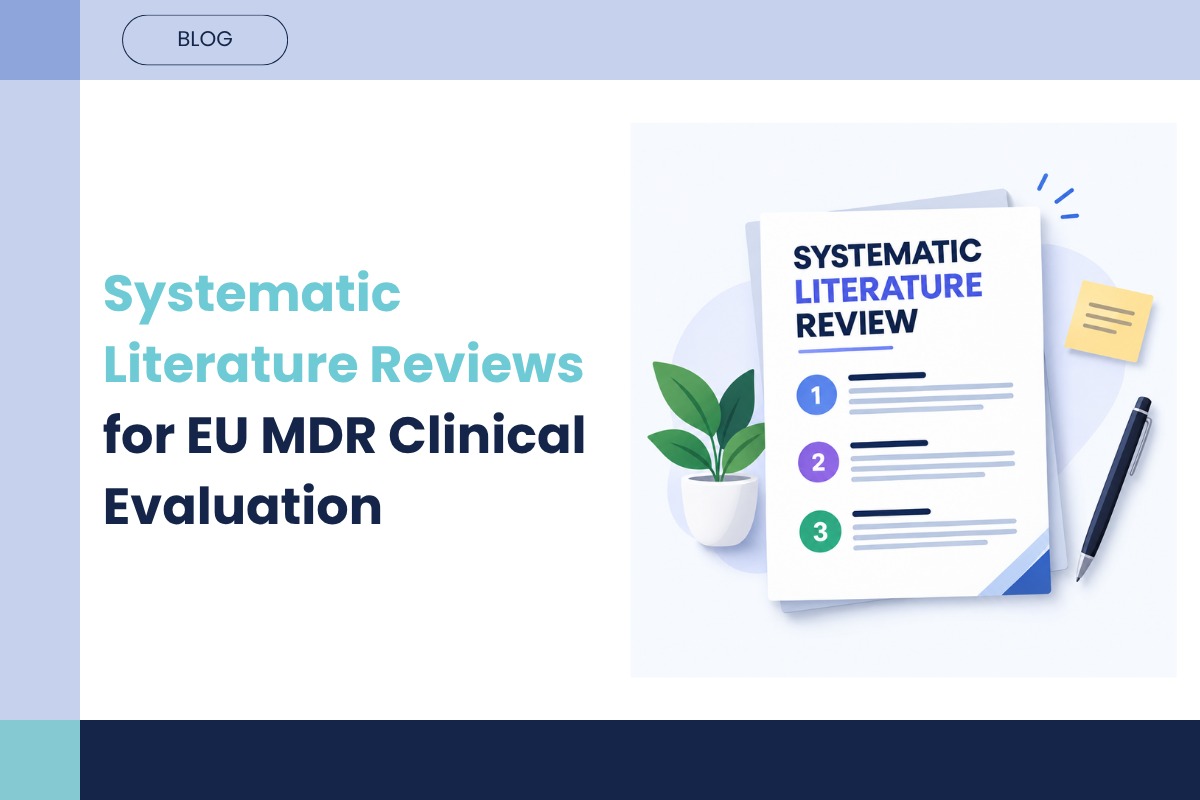
Optimizing Systematic Literature Reviews for CERs: Common Deficiencies and How to Avoid Them
20 Aug, 2026
Common deficiencies, Notified Body expectations, and how manufacturers can improve the consistency, traceability, and efficiency of clinical evidence reviews.
Under the European Union Medical Device Regulation (EU MDR), manufacturers must demonstrate that clinical evidence in their Clinical Evaluation Reports (CERs) is comprehensive, current, scientifically valid, and fully traceable to support the safety, performance, and clinical benefit of their medical devices. At the heart of every credible CER is a robust Systematic Literature Review (SLR), which provides the objective clinical evidence needed to substantiate regulatory claims.
As regulatory scrutiny continues to increase, Notified Bodies evaluate not only the conclusions presented in a CER but also the methodology used to identify, screen, appraise, and document supporting literature. Deficiencies in SLR methodology remain one of the most common reasons for regulatory questions, extended review cycles, and delays in certification. For medical device manufacturers, strengthening the quality of literature reviews is no longer simply a compliance exercise—it is a strategic step toward reducing regulatory risk and accelerating time-to-market.
Why SLR Quality Matters More Than Ever
Clinical evaluation under the EU MDR is expected to analyze data from literature in a manner that is complete, reproducible, transparent, and scientifically justified throughout the product lifecycle. During CER assessments, Notified Bodies closely examine whether manufacturers have followed a systematic and reproducible methodology for identifying and evaluating clinical evidence.
Regulatory reviewers generally expect manufacturers to demonstrate:
- Comprehensive and reproducible search strategies
- Clearly justified inclusion and exclusion criteria
- Transparent literature screening and study selection
- Systematic critical appraisal of evidence quality
- Complete documentation that supports independent verification
- Ongoing literature surveillance to maintain current clinical evidence
Even when the final clinical conclusions are scientifically sound, weaknesses in the literature review methodology can reduce confidence in the overall clinical evaluation and generate additional regulatory questions.
Common Deficiencies Identified During Regulatory Review
Despite comprehensive guidance available in MEDDEV 2.7/1 Rev. 4, MDCG 2020-6, and other guidance documents, several recurring deficiencies continue to be identified during Notified Body assessments:
- Incomplete search strategies: Searches that rely on a limited number of databases, use insufficient search terminology, or lack clear justification for the selected methodology may fail to capture relevant clinical evidence.
- Poor documentation and limited traceability: One of the most frequent findings relates to insufficient documentation. Missing search histories, undocumented screening decisions, inconsistent reviewer records, or incomplete evidence tracking make it difficult for reviewers to verify that the literature review was conducted systematically and objectively.
- Inconsistent evidence appraisal: Clinical studies should be evaluated using predefined and consistently applied quality assessment criteria. Subjective or poorly documented critical appraisal introduces uncertainty regarding how evidence was interpreted and incorporated into the CER.
- Outdated evidence: Clinical evidence is continually evolving through new publications, PMCF findings, and updated safety information. Reviews that are not regularly updated may overlook clinically relevant evidence, increasing the likelihood of regulatory questions during submission or surveillance activities.
- Manual and fragmented workflows: Many organizations continue to manage literature identification, screening, data extraction, and documentation using disconnected spreadsheets and multiple software tools. These manual processes increase the risk of errors, duplicate effort, inconsistent documentation, and reduced traceability across the review process.
Collectively, these deficiencies often lead to additional review cycles, requests for clarification, increased resource utilization, and delays in regulatory approval.
Supporting Regulatory Readiness and Reducing Approval Risk
For manufacturers operating under the EU MDR, regulatory readiness depends not only on generating clinical evidence but also on demonstrating that evidence has been collected and evaluated using a transparent, reproducible process.
AI-enabled literature modules can help strengthen this foundation by improving documentation quality, enhancing audit trails, supporting consistent review methodologies, and simplifying ongoing literature surveillance. These capabilities contribute to stronger evidence packages that are better prepared for Notified Body assessment and, where applicable, the additional scrutiny associated with the Notified Body Opinion process.
For organizations managing multiple products or complex clinical portfolios, greater automation can also improve operational efficiency by reducing manual effort, shortening CER preparation timelines, facilitating faster responses to regulatory queries, and supporting more predictable certification pathways. Ultimately, stronger evidence generation processes can help reduce avoidable regulatory delays and support faster market access.
Choosing the Right AI-enabled Platform for SLR
Several AI-enabled literature review tools are available that claim to help medical writing teams. While evaluating these tools, manufacturers should verify that the technology will not only improve consistency, traceability, and efficiency, but is also designed such that the workflow and the output from the tool will meet the requirements of the EU MDR and the evolving expectations from the Notified Body.
Before introducing an AI-enabled tool into your organization’s workflow, ask yourselves these questions:
- Does the tool allow for standardized search strategies?
- Does it automatically document search histories and screening decisions?
- Can this information be carried over to other CERs in the portfolio?
- Does this tool help maintain full traceability across every stage of evidence identification and evaluation?
- Does this tool support structured extraction of clinical data?
- Does it enable continuous literature surveillance for CER updates throughout the product lifecycle?
- Does it incorporate expert oversight in its workflow to substantiate the scientific accuracy of information?
- Does it meet applicable AI and data compliance requirements?
By reducing administrative burden and improving process consistency, AI allows medical writers, clinical evaluators, and regulatory professionals to focus on higher-value activities such as evidence appraisal, clinical interpretation, and scientific justification. At the same time, it must also be designed to maintain the scientific rigor and expert oversight that are critical for correct clinical interpretation and regulatory decision-making.
From Manual Literature Review to Traceable Evidence Management
CAPTIS® is Celegence’s purpose-built platform designed to support clinical evaluation and EU MDR evidence workflows. It helps regulatory and clinical teams manage literature reviews in a structured environment, supporting consistent screening, evidence organization, traceability, and reuse of regulatory knowledge across CER development and maintenance.
CAPTIS® helps our experts work smarter—not replace them. Scientific appraisal, clinical interpretation, and regulatory decisions remain with experienced professionals, while technology helps reduce repetitive administrative work and improve consistency across the evidence review process.
Looking Ahead
As the EU MDR continues to shape expectations for clinical evidence, the quality of systematic literature reviews will remain central to the credibility and defensibility of Clinical Evaluation Reports.
Digital and AI-enabled tools have the potential to support more consistent and efficient review processes, provided they are implemented with appropriate validation, scientific oversight, and expert judgment.
Ultimately, technology should be viewed as an enabler rather than a replacement for expertise and human intellect. The quality of a clinical evaluation will continue to depend on the knowledge and critical appraisal skills of clinical evaluators and regulatory professionals. With the right AI-enabled platform, these experts will be able to meet the NB expectations with greater consistency and quality, and minimize SLR related audit observations.
Strengthen Your Systematic Literature Review Strategy
Whether you are developing a new CER, updating an existing clinical evaluation, responding to Notified Body observations, or managing literature surveillance across a large device portfolio, Celegence combines MDR/IVDR expertise with purpose-built AI to support more structured, traceable, and efficient clinical evidence workflows.
AUTHORED BY

Senior SME, Medical Device Services
Dr. Alpa Ben

Other Related Articles

28 Aug, 2026
19 Aug, 2026

13 Aug, 2026
13 Aug, 2026
06 Aug, 2026

04 Aug, 2026