Regulatory Expertise and AI Acceleration: The Formula for Better CER Outcomes
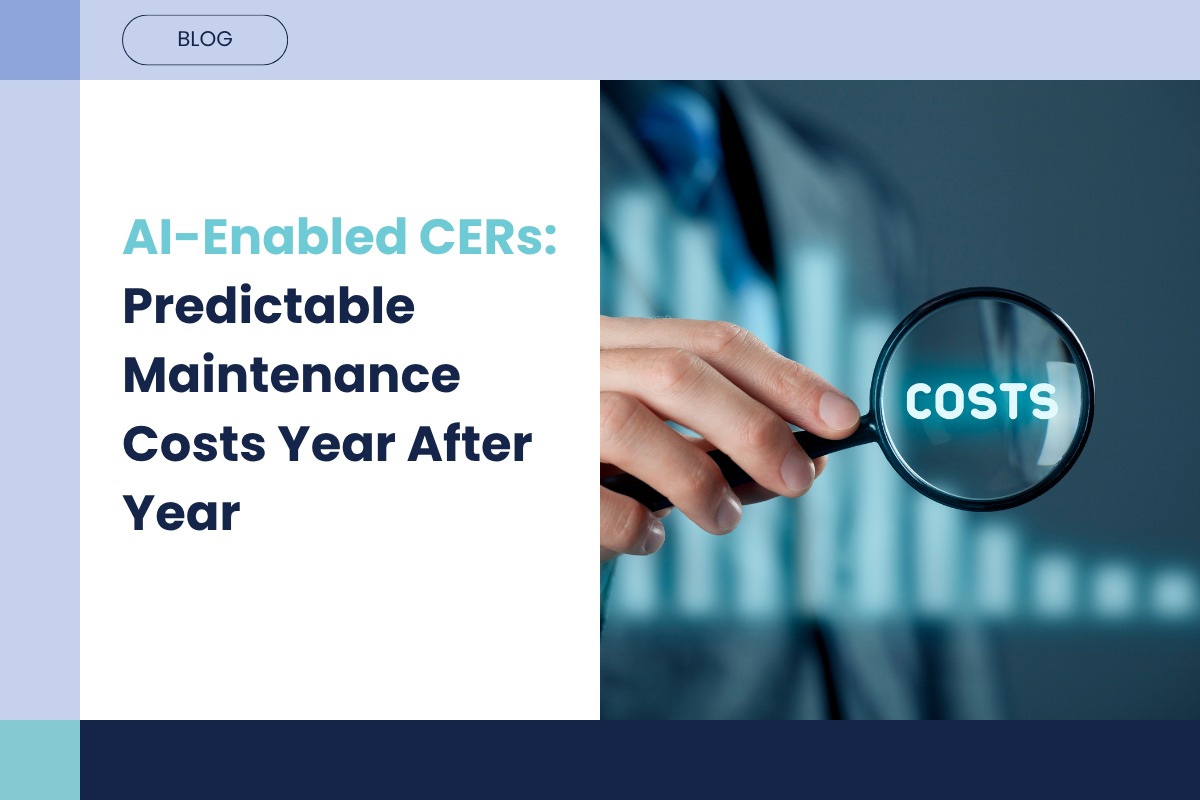
AI-Enabled Clinical Evaluation Reports (CERs): Ensuring Predictable Costs Year After Year
09 Sep, 2026
For many medical device manufacturers, the cost of developing a Clinical Evaluation Report (CER) is only the beginning. Under the EU Medical Device Regulation (EU MDR), clinical evaluation is not a one-time exercise but a lifecycle obligation that must be maintained and updated using relevant post-market surveillance (PMS), post-market clinical follow-up (PMCF), scientific literature, and other emerging clinical evidence.
Many manufacturers accurately budget for the initial CER but underestimate the long-term effort required to maintain it. As product portfolios grow and regulatory expectations continue to evolve, recurring CER updates can become a significant and often unpredictable regulatory expense. What begins as a single deliverable can quickly develop into an ongoing challenge involving resources, timelines, and compliance management across multiple products.
The commercial question therefore extends beyond; “How much will this CER cost?” A more strategic question is: “What will it cost to maintain this CER year after year?”
Why CER Maintenance Costs Become Difficult to Predict
Traditional CER development and maintenance remain heavily dependent on manual activities. Each update may require literature searches, publication screening, evidence extraction, clinical data review, reference verification, updates to evidence tables, and alignment of conclusions across interconnected regulatory documents.
While this effort may be manageable for a manufacturer maintaining a small number of devices, the challenge changes considerably as portfolios expand. Manufacturers responsible for multiple CERs often find themselves repeatedly reviewing similar literature, clinical evidence, and state-of-the-art information across related devices and product families. As the volume of documentation grows, so does the effort required to maintain consistency and compliance.
EU MDR reinforces this challenge by treating clinical evaluation as an ongoing process rather than a static report. Annex XIV requires manufacturers to identify, appraise, and analyze relevant clinical data through systematic scientific review while continuously incorporating PMS and PMCF findings into the clinical evaluation process.
When these activities are managed through largely manual workflows, each update can begin to resemble a new project rather than a continuation of existing regulatory knowledge.
Shifting from Rework to Knowledge Preservation
One of the most effective ways to improve the economics of CER maintenance is to move beyond a document-centric approach and focus on preserving regulatory knowledge.
A CER developed over several years may contain extensive literature assessments, appraisal decisions, evidence tables, and documented clinical conclusions. When this information exists only within static documents, teams often spend valuable time reconstructing or revalidating previously completed work during subsequent updates. A more structured approach enables evidence and regulatory rationale to be organized, maintained, and reviewed over time. Rather than rebuilding the evidence base during every review cycle, organizations can concentrate on evaluating what has changed and determining the impact on clinical conclusions.
This is where AI-enabled workflows can create meaningful value. AI can support high-volume and repetitive activities such as literature screening, evidence organization, structured data extraction, identification of potentially relevant new information, and maintenance of traceability. Regulatory and clinical experts can then focus on areas that require professional judgment, including clinical appraisal, state-of-the-art assessment, benefit-risk evaluation, and regulatory strategy.
The objective is not simply efficiency. It is creating a more sustainable approach to managing clinical evidence throughout the product lifecycle.
“Don’t pay repeatedly for work that technology can help preserve and reuse”
Expertise and AI: Working Together
Cost efficiency should never come at the expense of regulatory defensibility.
Successful implementation of AI within clinical evaluation depends on appropriate governance and expert oversight. While technology can assist with evidence management and information processing, regulatory decisions remain the responsibility of qualified professionals. Clinical interpretation, scientific judgment, and final clinical conclusions cannot be automated without compromising regulatory expectations.
This is why the most effective AI-enabled regulatory models combine purpose-built technology with experienced regulatory and clinical expertise. The goal is not to replace experts but to allow them to focus their efforts where they provide the greatest value.
Beyond efficiency, structured workflows can also strengthen traceability among clinical evidence, PMS outputs, PMCF activities, risk management documentation, and technical files. Improved alignment across these elements supports consistency throughout the quality and regulatory system and can simplify preparation for Notified Body reviews and deficiency responses.
From Individual CERs to Portfolio-Level Efficiency.
From One CER to Portfolio-Level Economics
The commercial impact is directly proportional to structured evidence management becoming increasingly significant as the number of devices grows.
When each CER is managed as an isolated project, manufacturers may repeatedly invest time and resources reviewing similar evidence, conducting comparable assessments, and performing administrative activities across multiple documents. Over time, this can create a substantial maintenance burden.
By organizing evidence and regulatory knowledge more effectively, manufacturers can focus updates on genuinely new information while improving consistency across related product families.
This can support:
- More efficient CER maintenance activities
- Better utilization of previously assessed evidence
- Faster identification of relevant new literature
- Greater consistency across product families
- Improved alignment between CER, PMS, PMCF, and risk management documentation
- Enhanced visibility into future regulatory workload
- More efficient portfolio-level lifecycle management
The outcome is not simply a faster CER update cycle. It is a more scalable approach to managing clinical evaluation obligations across an entire product portfolio. By improved efficiency; it is a fundamentally more scalable approach to regulatory compliance. Successful AI-enabled CER programs are built on the intersection of advanced technology, regulatory knowledge, and robust lifecycle governance. Organizations that establish workflows capable of retaining institutional expertise, safeguarding evidence traceability, and supporting informed portfolio-level decisions create lasting operational value. Rather than starting from scratch with every update, they are able to systematically build upon prior knowledge, resulting in greater consistency, efficiency, and long-term compliance performance.
Predictable Costs Must Still Deliver Defensible Outcomes
Commercial predictability is important, but manufacturers should evaluate CER partners based on more than cost alone.
Key questions remain:
- Can the evidence be traced throughout the clinical evaluation?
- Are the clinical conclusions scientifically supported?
- Is there alignment between CERs and supporting documentation such as PMS, PMCF, and risk management files?
- Can the team effectively support Notified Body questions and deficiency responses?
- Is the approach sustainable for future review cycles?
The long-term value of a CER program is ultimately measured not by the speed of document creation but by its ability to withstand regulatory scrutiny while remaining efficient to maintain over time without rebuilding the process from the ground up every single time?
Celegence’s approach is centered on long-term regulatory partnership rather than a transactional document delivery model. This enables manufacturers to receive support across the entire product lifecycle, from regulatory strategy and CER authoring to submission management, Notified Body interactions, and post-market activities. By prioritizing continuity, consistency, and lifecycle management, the model is designed to help organizations maintain compliance while reducing the operational burden associated with recurring CER updates.
This commitment to regulatory excellence is reflected in Celegence’s reported performance metrics, including over 98% on-time, on-quality delivery, fewer than 15 Notified Body comments per CER on average, and more than 90% of CER packages achieving approval by the second round of Notified Body clinical review. These outcomes highlight the value of combining regulatory expertise, evidence-driven methodologies, and scalable processes to support long-term compliance success.
Building a More Sustainable Approach to Clinical Evaluation
The real value of AI-enabled CER development extends beyond reducing the effort associated with the next update. It lies in establishing a scalable, sustainable, and predictable framework for clinical evaluation throughout the device lifecycle. For manufacturers managing expanding portfolios and evolving MDR obligations, combining structured regulatory knowledge, purpose-built technology, and experienced regulatory expertise can help reduce inefficiencies while preserving the quality, traceability, and scientific rigor expected by Notified Bodies.
As regulatory expectations continue to evolve, organizations that view clinical evaluation as an ongoing strategic capability rather than a periodic documentation exercise will be better positioned to manage compliance, support portfolio growth, and maintain regulatory readiness. The greatest value of AI-enabled CER programs lies not in automation alone, but in enabling a more connected, consistent, and resilient regulatory operating model for the future.
Contact our experts to explore how AI-enabled CER workflows can support a more efficient, sustainable, and compliant approach to CER lifecycle management.
Other Related Articles
20 Aug, 2026
19 Aug, 2026

13 Aug, 2026
13 Aug, 2026
06 Aug, 2026
04 Aug, 2026