
Regulatory Expertise and AI Acceleration: The Formula for Better CER Outcomes
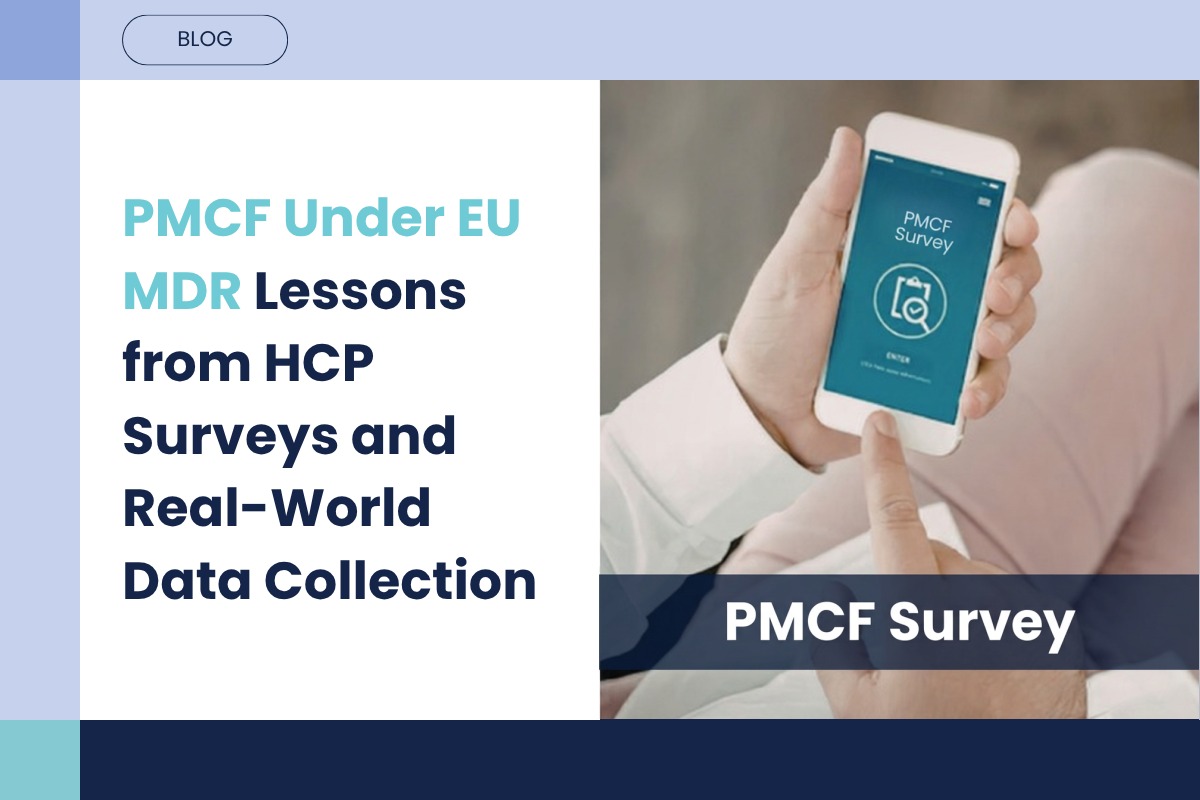
PMCF Under EU MDR: Lessons from HCP Surveys and Real-World Data Collection
29 Jul, 2026
Under EU MDR Annex XIV Part B, Post-Market Clinical Follow-up (PMCF) is no longer a periodic regulatory obligation—it is a continuous, proactive process that generates clinical evidence throughout a device’s lifecycle. PMCF must remain aligned with the broader clinical evidence ecosystem, including Clinical Evaluation Reports (CERs), Post-Market Surveillance (PMS) activities, Risk Management Files, Periodic Safety Update Reports (PSURs), and other supporting documentation.
Among the many approaches available to manufacturers, Healthcare Professional (HCP) surveys and Real-World Data (RWD) collection have become valuable tools for addressing clinical evidence gaps in a practical and proportionate manner. However, successful implementation requires more than simply collecting additional data. It demands a strategic, scientifically sound approach that aligns with regulatory expectations and integrates seamlessly into the broader clinical evidence framework.
The following lessons can help manufacturers effectively integrate HCP surveys and RWD into their PMCF strategies under EU MDR.
1. Define the Clinical Question First
Effective PMCF begins by identifying the clinical question—not the data collection method. Manufacturers should first determine the evidence gap, relevant endpoints, patient population, and intended use before deciding whether an HCP survey or RWD is the most appropriate approach.
HCP surveys are particularly useful for understanding clinical practice, user experience, training needs, and reporting behaviors, while RWD is better suited for evaluating safety, performance, long-term outcomes, and event rates. Selecting the right method for the right objective significantly strengthens the credibility of the evidence.
2. Apply a Proportionate, Risk-Based Approach
PMCF activities should be proportionate to the device’s risk profile, i.e. classification, novelty, intended use, residual risks, and target patient population. Rather than conducting unnecessarily complex studies, manufacturers should justify why the selected data source, endpoints, and study design are appropriate for addressing identified clinical gaps.
Notified Bodies are increasingly focused on clinical evidence that is fit for purpose rather than simply extensive.
3. Ensure Methodological Rigor and Traceability
Whether collecting survey data or RWD, manufacturers should clearly document study rationale, study design, participant selection, inclusion criteria, analysis methods, potential biases, and study limitations.
Equally important is ensuring that findings are traceable across the clinical evidence framework. PMCF outputs should align with CER conclusions, PMS findings, Risk Management Files, labeling, and PSUR benefit-risk assessments. Strong traceability demonstrates that PMCF is an integrated part of the quality management system rather than an isolated activity.
4. Build Sustainable and Repeatable PMCF Programs
PMCF is a continuous lifecycle activity under EU MDR, not a one-time study. Manufacturers should therefore establish processes that are both operationally sustainable and repeatable over time.
Real-world evidence generation often requires considerable investment in registries, data management, statistical analysis, privacy compliance, and ongoing maintenance. Rather than committing to overly ambitious studies that may be difficult to sustain, manufacturers should design realistic PMCF programs that can be consistently repeated throughout the device lifecycle.
Repeatability can be achieved by maintaining:
- Version-controlled protocols
- Standardized endpoint definitions
- Documented data dictionaries
- Repeatable data extraction methods
- Audit trails
- Controlled change management
These practices ensure consistency across successive PMCF cycles, facilitate meaningful trend analysis, and support long-term regulatory compliance. Smaller, well-designed studies that can be repeated consistently often provide greater regulatory value than large, one-time initiatives.
5. Design HCP Surveys as Scientific Evidence
HCP surveys can provide valuable clinical insights that are not always captured through quantitative data, including:
- Clinical practice patterns
- Device selection and usability
- Perceived performance
- Training gaps
- Reasons for adverse event underreporting
However, surveys intended to support regulatory decisions should be designed with the same scientific rigor as other clinical evidence. Appropriate participant selection, unbiased questionnaires, representative sampling, and predefined analytical methods are essential to producing credible results.
6. Prioritize Data Quality Over Data Volume
The strength of HCP surveys and RWD lies in its relevance and quality. Notified Bodies evaluate whether datasets are complete, use consistent endpoint definitions, provide sufficient follow-up, and reflect current clinical practice.
For legacy devices, the key consideration is not simply the age of the data, but whether changes in technology, labeling, patient populations, or clinical practice have affected its continued applicability.
7. Strengthen PMCF with Digital Literature Review Management
Generating new evidence is only part of PMCF. Managing published clinical evidence efficiently is equally important. Digital literature review platforms such as CAPTIS® help manufacturers streamline literature surveillance by replacing manual spreadsheets with centralized, traceable workflows.
Key benefits include:
- Centralized literature management
- Transparent inclusion and exclusion decisions
- Consistent review workflows
- Repeatable search strategies
- Improved readiness for regulatory submissions
Perhaps the greatest advantage is reproducibility. As PMCF is a continuous lifecycle activity, manufacturers must demonstrate consistent literature surveillance over time. Digital platforms enable repeatable searches, maintain complete audit trails, and ensure that literature reviews remain transparent and aligned with regulatory expectations.
8. Integrate Multiple Evidence Streams
The strongest PMCF programs combine multiple complementary evidence sources rather than relying on a single dataset. Scientific literature establishes the state of the art, PMS identifies emerging trends, HCP surveys provide clinical context, RWD measures real-world performance, and Risk Management demonstrates how identified hazards are monitored and controlled. Together, these inputs support updated CERs and robust benefit-risk conclusions.
When these evidence streams reinforce one another, manufacturers can present a more complete, transparent, and defensible demonstration of device safety and performance.
Conclusion
HCP surveys and RWD have become essential components of PMCF under EU MDR when they are designed around clear clinical questions, supported by robust methodology, and integrated into the wider clinical evidence framework. Equally important is the ability to manage literature efficiently using digital platforms such as CAPTIS®, which improve traceability, consistency, and reproducibility throughout the evidence generation process.
Ultimately, successful PMCF is not about collecting more data—it is about generating and managing evidence that is relevant, reliable, and sufficient to demonstrate the continued safety, performance, and clinical benefit of medical devices throughout their lifecycle.
Build a stronger PMCF strategy
Whether you’re designing a PMCF programme, responding to Notified Body observations, or maintaining clinical evidence across a product portfolio, Celegence combines regulatory expertise, accelerated by AI through CAPTIS®, to help you generate defensible evidence, streamline literature management, and maintain audit-ready documentation.
AUTHORED BY

Manager/Senior SME, Medical Device Services
Neha Keral

Other Related Articles
20 Aug, 2026
19 Aug, 2026

13 Aug, 2026

13 Aug, 2026

06 Aug, 2026

04 Aug, 2026