
Getting Started with Your First Clinical Evaluation Report (CER) for a Small Medical Device Company
EU MDR Checklist: Technical Documentation Requirements for Medical Device Manufacturers

04 Aug, 2026
Introduction
The European Medical Device Regulation (EU MDR 2017/745) has fundamentally changed how medical device manufacturers demonstrate compliance. Beyond achieving CE marking, manufacturers are expected to maintain comprehensive technical documentation, generate robust clinical evidence, and continuously monitor device performance throughout the product lifecycle. As regulatory expectations and Notified Body scrutiny continue to evolve, having a structured approach to EU MDR compliance is essential. This guide outlines the key technical documentation requirements and includes a practical checklist to help manufacturers prepare for submissions, identify documentation gaps, and maintain ongoing compliance.
Is Your Technical Documentation Ready for EU MDR?
Meeting the requirements of the European Medical Device Regulation (EU MDR 2017/745) extends well beyond obtaining CE marking. Manufacturers must demonstrate continuous compliance throughout the entire product lifecycle by maintaining complete, current, and audit-ready technical documentation. For many manufacturers, technical documentation remains one of the most scrutinized aspects of a Notified Body assessment and a common source of nonconformities.
Whether you are preparing your first EU MDR submission, transitioning legacy devices, or maintaining an existing portfolio, having a structured compliance checklist can simplify planning and reduce regulatory risk. This checklist highlights the key elements every manufacturer should evaluate before a regulatory submission or surveillance audit.
Why an EU MDR Checklist Matters
EU MDR introduced significantly higher expectations for clinical evidence, risk management, post-market surveillance, and technical documentation than the previous Medical Device Directive (MDD).
Today’s manufacturers are expected to maintain documentation that is:
- Complete and consistent across the Technical File
- Supported by current clinical evidence
- Continuously updated throughout the device lifecycle
- Traceable across all supporting documents
- Ready for Notified Body review at any time
A structured checklist helps regulatory teams identify documentation gaps early, prioritize remediation activities, and prepare more efficiently for regulatory submissions and surveillance audits.
This checklist is valuable for:
- Regulatory Affairs professionals
- QA teams
- PMS/PMCF specialists
- Clinical Evaluation teams
- Manufacturers transitioning legacy MDD devices to MDR
What Should Your Technical Documentation Include?
Under EU MDR Annex II and Annex III, technical documentation should include, as applicable:
Device Description
- Device identification
- Intended purpose
- Intended users
- Classification rationale
- Product variants and accessories
General Safety and Performance Requirements (GSPR)
Demonstrate compliance with applicable clinically relevant General Safety and Performance Requirements through objective evidence, standards, testing, and supporting documentation.
Clinical Evaluation
Clinical evidence should demonstrate that the device achieves its intended purpose while maintaining an acceptable benefit-risk profile.
Supporting documentation typically includes:
- Clinical Evaluation Plan (CEP)
- Clinical Evaluation Report (CER)
- Systematic Literature Review (SLR)
- Benefit-risk assessment
- State-of-the-art evaluation
Clinical Evaluation should be continuously updated using post-market data, literature surveillance, vigilance information, and PMCF outcomes to demonstrate continued safety and performance.
Risk Management
Risk Management documentation should align with ISO 14971 and remain fully connected with clinical evaluation and post-market evidence.
Post-Market Surveillance (PMS)
Manufacturers must establish procedures to proactively collect and evaluate real-world performance data throughout the device lifecycle.
Supporting documents often include:
- PMS Plan
- PMS Report or PSUR
- Trend reporting
- Vigilance procedures
Post-Market Clinical Follow-up (PMCF)
PMCF activities provide ongoing clinical evidence supporting device safety and performance after-market placement.
Documentation may include:
- PMCF Plan having details of general or specific PMCF activities
- PMCF Evaluation Plan
- PMCF Report
Summary of Safety and Clinical Performance (SSCP)
For applicable devices, manufacturers must prepare and maintain an SSCP that is consistent with the Clinical Evaluation Report and Technical Documentation.
Verification and Validation Reports
Manufacturers should ensure that Verification and Validation documentation demonstrates:
- Compliance with applicable GSPRs.
- Verification of all design inputs.
- Validation of the intended purpose and clinical performance.
- Compliance with applicable harmonized or state-of-the-art standards.
- Adequate testing under worst-case and representative use conditions.
- Traceability between design inputs, verification activities, validation activities, and design outputs.
Common Challenges Manufacturers Face (Common Notified Body Observations)
Although most organizations understand the documentation requirements, maintaining compliance is becoming increasingly challenging.
Common issues include:
- Inconsistencies between technical documents
- Insufficient clinical evidence
- Inadequate literature search methodology
- Unsupported clinical claims
- Weak benefit-risk justifications
- Maintaining CERs across large product portfolios
- Keeping PMS and PMCF documentation synchronized
- Responding efficiently to Notified Body observations
- Demonstrating traceability between evidence and conclusions
- Managing documentation updates across multiple product families
- Preparing for recurring surveillance reviews
- Poor traceability between clinical evidence and regulatory requirements
Identifying and addressing these gaps before submission can significantly reduce review cycles.
Preparing for Notified Body Review
Successful submissions depend on more than complete documentation.
Notified Bodies increasingly expect:
- Strong scientific justification
- Clear benefit-risk conclusions
- Consistent information across the Technical File
- Current literature and clinical evidence
- Robust PMS and PMCF integration
- Complete traceability from evidence to regulatory conclusions
Organizations that establish structured documentation processes are generally better positioned to reduce review cycles and respond more efficiently to regulatory questions.
Download the Free EU MDR Checklist
Make Sure Nothing Gets Missed
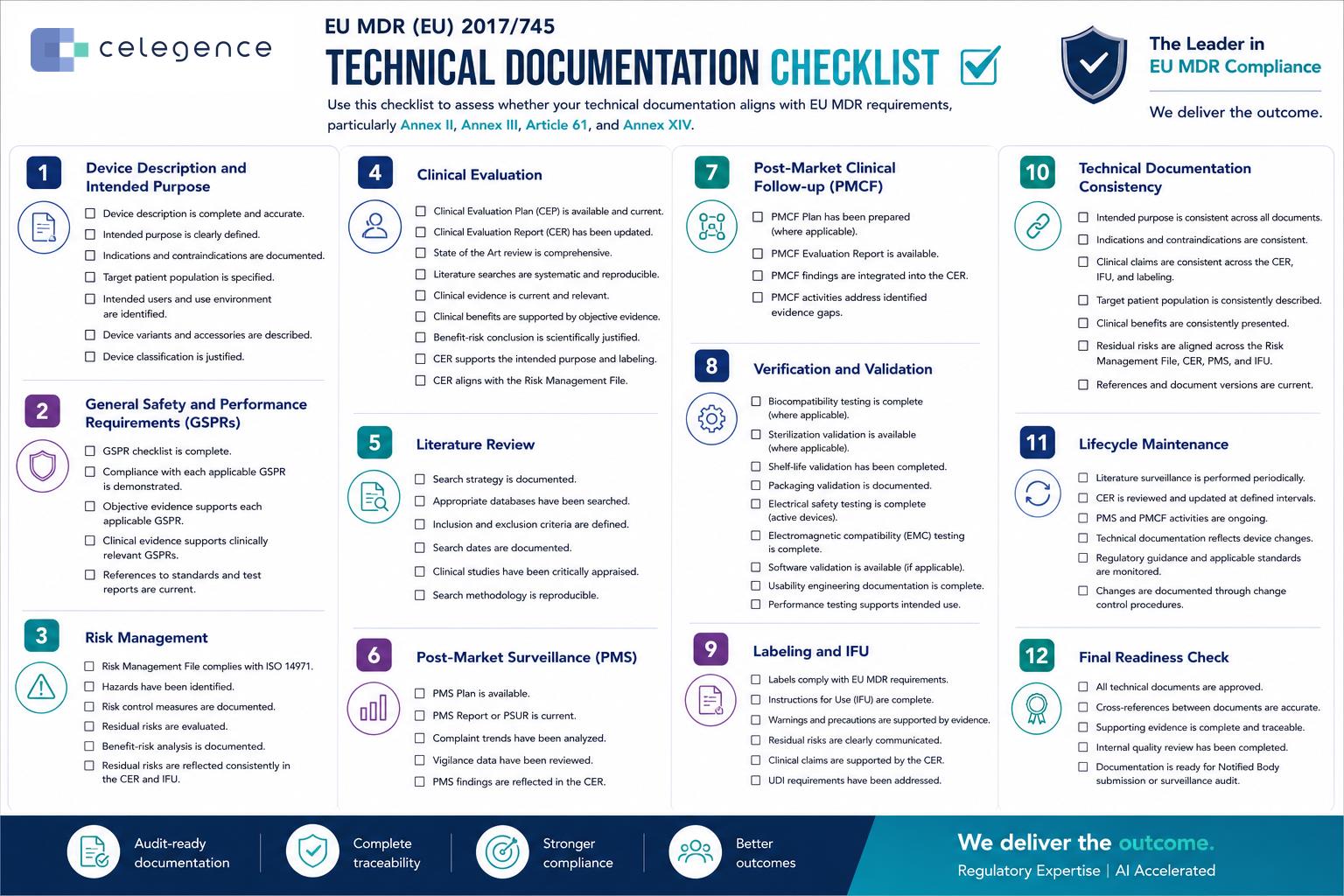
The most successful EU MDR submissions are built on consistency, traceability, and lifecycle management. Rather than treating each document as a standalone deliverable, ensure that your CER, Risk Management File, PMS documentation, PMCF activities, GSPR checklist, labeling, and Instructions for Use are fully aligned and supported by current, objective evidence.
Whether you’re preparing for an initial submission, updating existing Technical Documentation, or planning future maintenance activities, this checklist can help your team identify potential gaps before a Notified Body does.
👉 Download the Free EU MDR Checklist
Building Long-Term EU MDR Compliance
EU MDR compliance is no longer a one-time regulatory milestone – it is an ongoing operational responsibility. As product portfolios grow and documentation requirements evolve, manufacturers need repeatable processes that improve consistency, preserve knowledge, and simplify future maintenance.
At Celegence, we believe anyone can write the document. We deliver the outcome. By combining regulatory expertise, accelerated by AI, we help manufacturers build audit-ready documentation that supports efficient maintenance, stronger traceability, and successful Notified Body interactions throughout the product lifecycle.
Contact us at info@celegence.com to learn more about CAPTIS® and our MDR compliance services.
AUTHORED BY

Manager/Senior SME, Medical Device Services
Rohan Sathe

Other Related Articles

30 Sep, 2026

18 Sep, 2026


09 Sep, 2026

28 Aug, 2026
20 Aug, 2026