Optimizing Systematic Literature Reviews for CERs: Common Deficiencies and How to Avoid Them
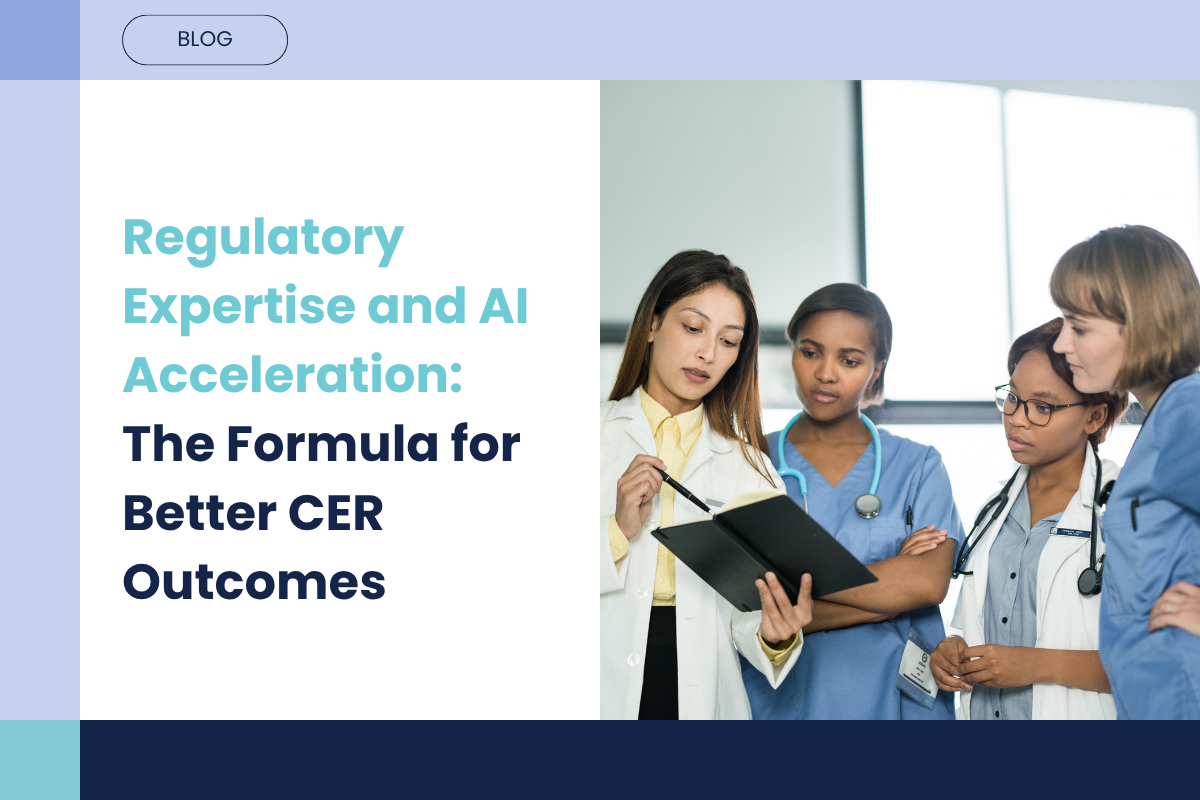
Regulatory Expertise and AI Acceleration: The Formula for Better CER Outcomes
28 Aug, 2026
Purpose-built AI can accelerate the work. Regulatory experts provide the clinical judgment, scientific reasoning, and accountability required for defensible EU MDR clinical evaluation.
Anyone who has managed a Clinical Evaluation Report recently will recognize the pressure. A literature search that once produced a manageable collection of publications can now return thousands of records. Before the clinical significance of the evidence can even be discussed, teams must remove duplicates, screen abstracts, retrieve full texts, extract study data, update evidence tables, and preserve a traceable record of every decision.
That work is essential, but it consumes time that experienced clinical and regulatory professionals could otherwise spend assessing study quality, interpreting outcomes, identifying evidence gaps, and evaluating benefit-risk.
At the same time, regulatory expectations are not becoming simpler. Under Regulation (EU) 2017/745, clinical evaluation is a continuous lifecycle activity. It must remain connected to the intended purpose, risk-management process, post-market surveillance, and post-market clinical follow-up. The CER is therefore not merely a report to be produced for submission. It is a living regulatory assessment that must evolve with the device and its evidence base.
Artificial intelligence offers a credible way to manage some of this complexity, but only when its role is properly understood.
AI can accelerate how evidence is found, organized, and prepared for review. It cannot assume responsibility for determining whether that evidence supports a clinical claim or an acceptable benefit-risk conclusion.
“That distinction defines the most sustainable model for future CER development”
Why CER Development Is Becoming More Difficult to Scale
A defensible CER must bring together several evidence streams and convert them into a coherent regulatory argument.
The evaluator must consider evidence relating to the subject device, similar or equivalent technologies, the medical condition, available treatment alternatives, relevant safety outcomes, and the current state of the art. That evidence must then be examined for methodological quality, relevance to the intended population, applicability to the subject device, and contribution to the overall clinical evaluation.
The challenge is not limited to volume. Clinical literature is rarely uniform. Device names may change between generations, outcome definitions may differ across studies, adverse events may be reported inconsistently, and several publications may originate from the same patient population.
MDCG 2020-6 reinforces that sufficient clinical evidence depends on the quality and relevance of the available data, not simply the number of publications collected. A large evidence library does not automatically support a strong CER. It still requires qualified interpretation.
Consider a typical CER update that returns 2,500 records. Before scientific appraisal begins, the team must:
- Identify and remove duplicates
- Apply inclusion and exclusion criteria
- Review titles and abstracts
- Retrieve potentially relevant full texts
- Confirm the device, indication, and population
- Extract safety and performance data
For one device, this may be manageable. Across a portfolio of products with different update schedules, it can become a significant operational constraint.
Where AI Can Make a Meaningful Difference
AI is particularly valuable where the work is repetitive, evidence-intensive, and based on defined rules.
In a controlled CER workflow, AI can support:
- Literature screening and prioritization
- Duplicate and related-publication detection
- Evidence classification
- Structured data extraction
- Document interrogation
- Preliminary study summaries
- Evidence-table development
- Source linking and traceability
For example, AI may rank records according to predefined relevance criteria and present a prioritized collection for review. The clinical evaluator can then focus attention on the most likely relevant studies while retaining responsibility for the final inclusion and exclusion decisions.
AI can also transfer study characteristics, patient demographics, clinical endpoints, follow-up periods, adverse events, and performance results into an approved template. This can reduce transcription effort, but the extracted information must still be verified against the original publication.
The objective is not to replace qualified professionals. It is to prevent their expertise from being consumed by work that technology can help perform more efficiently.
Why AI Alone Cannot Produce a Defensible CER
AI can process language and recognize patterns, but a CER requires contextual judgment.
A system may extract a favourable performance result without recognizing that the study evaluated an earlier device generation. It may overlook the fact that follow-up was too short to evaluate a known risk or that the study population does not reflect the intended users of the subject device.
It may summarize an endpoint accurately while failing to question whether that endpoint demonstrates a meaningful clinical benefit. It may also treat multiple publications from the same investigation as independent evidence, unintentionally giving one dataset disproportionate weight.
Generative systems introduce additional concerns. They can produce convincing statements that are not fully supported, misattribute findings, remove important qualifications, or generate inaccurate references. In a regulated clinical evaluation, such errors can affect evidence sufficiency, clinical claims, and benefit-risk conclusions.
A qualified evaluator must therefore be able to:
- Access the original source.
- Verify the extracted information.
- Understand why evidence was selected.
- Identify uncertainty and methodological limitations.
- Challenge or reject the proposed output.
- Document the final regulatory rationale.
Human review is not meaningful if it occurs only after an opaque system has produced a completed report. Expert involvement must be present throughout the workflow.
The Hidden Risk of Remaining Fully Manual
The limitations of AI deserve careful attention. However, avoiding AI does not eliminate risk.
Organizations that continue to depend entirely on manual CER processes may face longer timelines, higher costs, inconsistent evidence handling, limited portfolio scalability, and greater dependence on scarce specialist resources.
Manual processes can also introduce quality concerns. Repetitive screening contributes to reviewer fatigue. Transcription creates opportunities for error. Evidence decisions may be recorded inconsistently across projects, and relevant publications may be overlooked as search results grow.
The regulatory and commercial tension is becoming difficult to ignore:
Overreliance on AI creates compliance risk. Failure to use AI effectively creates operational and competitive risk.
Neither extreme offers a sustainable solution. The objective should be to automate appropriate tasks while preserving qualified control over decisions that affect regulatory conclusions.
What the EU AI Act Signals for CER Teams
The EU AI Act introduces a binding, risk-based framework covering artificial intelligence. For medical technology organizations, its significance extends beyond product classification. It signals a broader expectation for accountable governance, data quality, transparency, human oversight, technical traceability, lifecycle monitoring, and controlled change.
MDCG 2025-6 explains that the AI Act complements the MDR and IVDR by addressing AI-specific risks not explicitly covered by medical device legislation. Where a medical device contains a high-risk AI system, the relevant frameworks apply simultaneously and complementarily.
An internal AI tool used for literature screening or CER drafting is not automatically equivalent to a high-risk AI-enabled medical device. Its intended purpose, use, and applicable legal classification must be assessed separately.
Nevertheless, the underlying governance principles remain highly relevant. An organization using AI in CER development should be able to explain:
- The task the system is intended to perform
- The data and sources it is permitted to use
- The limitations identified during validation
- The qualifications of responsible reviewers
- How errors and overrides are documented
- How system changes are assessed and controlled
- How performance is monitored over time
- Who remains accountable for final decisions
These controls are not barriers to innovation. They are what make innovation credible in a regulated environment.
Responsible Acceleration Requires Strong Governance
As AI becomes part of regulatory operations, capability alone is not enough. Organizations must consider how the technology is validated, secured, controlled, and monitored.
ISO/IEC 42001 provides a management-system framework for the responsible development and use of AI. ISO/IEC 27001 provides a structured approach to information-security management. Together, these standards can support:
- Defined accountability
- Risk-based implementation
- Data and information security
- Transparent operating controls
- Version and change management
- Performance monitoring
- Continual improvement
Governance should also include source-level traceability, approved use cases, standardized review procedures, documented overrides, escalation criteria, and periodic evaluation of AI-assisted outputs.
Strong governance is not merely a compliance safeguard. It enables organizations to adopt technology with greater confidence and scale it without losing control.
The Formula for Better CER Outcomes
AI and regulatory experts contribute different strengths. AI provides speed, repeatability, scalability, automation, and the capacity to process large volumes of information.
Regulatory experts provide clinical insight, critical appraisal, scientific reasoning, benefit-risk interpretation, regulatory strategy, and accountable decision-making.
Neither capability is sufficient on its own.
AI without expert oversight may produce output quickly, but speed cannot compensate for weak reasoning or unsupported conclusions. A fully manual model preserves expert control but may become difficult to sustain as evidence volumes, device portfolios, and regulatory expectations continue to grow.
The better model combines both within a transparent and controlled workflow.
Before selecting an AI-supported CER solution, manufacturers should ask:
- Was regulatory expertise involved in its design?
- Can every material output be traced to a source?
- Are expert decisions and overrides documented?
- Has the workflow been validated for its intended use?
- Are limitations clearly communicated?
- Are system changes controlled?
- Is confidential information protected?
- Can the methodology be explained during regulatory review?
These questions distinguish regulatory-led AI from generic content automation.
We Deliver the Outcome
Celegence is putting this human-AI partnership into practice through CAPTIS®, the integrated technology environment that enables its expert-led regulatory medical writing services. Within a unified CER workflow, CAPTIS brings together literature review outputs, project documents, source evidence, and AI-assisted drafting, allowing Celegence’s medical writers to interrogate project content, extract structured data from scientific articles, and develop traceable first drafts grounded in approved sources. Every output remains subject to expert verification, scientific interpretation, and regulatory judgment, with source-level traceability making the evidence easier to challenge and validate. By embedding AI into the workflow rather than treating it as a standalone writing tool, Celegence enables its medical writers to spend less time gathering and compiling information and more time evaluating evidence, strengthening the regulatory narrative, and delivering defensible CER outcomes.
Conclusion
The future of clinical evaluation will not be defined by how many experts can be removed from the process. It will be defined by how effectively technology allows those experts to focus on the work that requires clinical and regulatory judgment.
AI can accelerate literature review, evidence extraction, organization, traceability, and preliminary drafting. It cannot own evidence-sufficiency decisions, benefit-risk reasoning, or final CER conclusions.
Organizations such as Celegence, which combine regulatory knowledge with purpose-built AI capabilities, represent a practical model for this next stage of clinical evaluation. The value is not automation alone. It is acceleration within a framework of qualified oversight, transparent evidence, and accountable governance.
Connect with Celegence to explore how an expert-governed, AI-assisted approach can support faster, more consistent, audit-ready, and regulator-defensible CER development.
AUTHORED BY

Associate Manager - Medical Device Services
Abhay Sajeev Nair

Other Related Articles
19 Aug, 2026

13 Aug, 2026
13 Aug, 2026
06 Aug, 2026

04 Aug, 2026

29 Jul, 2026